A project exists, a delivery approach has to be chosen, and the choice has to be defended to whoever signs off on the budget. But that decision cycle is harder than it looks. The software development methodologies on offer are described mostly by the people who champion them, and every one of them sounds correct in isolation. Waterfall promises predictability. Scrum promises responsiveness. Neither promise means anything until it meets a specific set of constraints — a fixed-price contract, a certification body, a team of four, a release window controlled by someone else.
Pure adoptions are actually much less prevalent than the marketing suggests. According to the research conducted by digital:ai and published in October 2025 as the 18 th State of Agile report, 74% of the respondents who provide insights into their software development practices use a hybrid, blended, or home-grown approach to Agile, not a single, pure methodology
The article then goes on to evaluate 17 different software development methods. The guide groups them by whether they assume requirements are discovered upfront, during construction, or a mix of the two. Seven selection criteria follow, covering the constraints that decide the choice in practice: requirement stability, user access, project size, timeline, team distribution, team maturity, and budget structure.
What Is a Software Development Methodology?
A software development methodology refers to a set of principles that a group of individuals responsible for creating computer programs adopts. These rules provide:
- guidelines regarding the prioritization of certain activities;
- the circumstances under which requirements are considered met or revised;
- what tests a particular build needs to pass through before it can be deployed to actual users.
Teams choose to follow them in order to ensure predictable launches.
The term covers more than a schedule. A methodology organizes the system development life cycle into named phases, then states what has to be true before one phase closes. Requirements gathering, design, implementation, testing, deployment, maintenance — those phases stay broadly consistent across software development models. What changes is whether they run once, repeat on a fixed rhythm, or overlap continuously.
Underneath sits process management:
- who decides.
- who signs off.
- how often the plan gets revisited.
A scope change on a defense contract travels through a written change order. A cost impact assessment, and a review board that meets twice a month. The same change on a consumer product reaches a product owner over Slack and enters the next sprint. Both are legitimate. They are governed by different software development methodologies, and picking the wrong one for the contract type is how programs stall.
Communication rules follow the cadence. Standups, demo days, phase-gate reviews, and written specifications circulated for comment are each software development models that prescribe a different mix. This mix then has to survive the distance to the stakeholders from the development team.
Quality assurance is defined by placement more than by technique. Waterfall concentrates testing into a phase after implementation is finished. The V-model pairs a test activity with every design activity, so an acceptance test gets written while the requirements document is still open. Pipeline-driven models push verification into the commit itself, where a failing build surfaces in under ten minutes.
Risk and adaptability separate the models most sharply. A methodology either front-loads risk analysis and then defends the plan, or it treats requirement change as certain and builds re-planning into the calendar. That one choice drives most of the cost difference downstream.
The said rules govern the allocation and sequencing of work in a project. More prescriptive methods, such as Scrum and Kanban, mandate specific roles, paperwork, and rituals that are supposed to facilitate a continuous cycle of development and testing. Finally, there is DevOps, an emerging practice that aims to reshape the relationship between the two sides. It gives both more responsibility over the production process than is traditionally the case.
Software Development Approaches: Sequential, Agile, and Hybrid
Every methodology answers one question before it answers any other: how much can be known before the work starts? The answer splits software development approaches into three families. It explains why two competent teams reading the same brief will organize themselves in ways that look nothing alike.
Sequential approaches assume the problem can be understood up front. Requirements are gathered, specified, and signed off before design begins; design is finished before implementation starts. Predictability is the payoff. So is a documentation trail an auditor can follow eighteen months later. This is why sequential types of development methodologies persist in aerospace, medical devices, and public procurement long after the rest of the industry moved on. Rigidity is the price. A requirement discovered in month seven has to travel back through phases that already closed.
Agile approaches invert the assumption. Learning happens during development. So, the plan is deliberately incomplete and gets corrected on a fixed rhythm. Teams ship working software in short iterations, put it in front of stakeholders, and let what comes back reshape the backlog. Total scope and budget resist advance commitment, which is uncomfortable for anyone signing a fixed-price contract.
Hybrid models start from a different premise. Neither pure predictability nor pure adaptability survives contact with a real organization, so the two get combined on purpose. A program might lock architecture and compliance scope through a phase gate, then run feature delivery in sprints underneath that ceiling. This is where the industry has actually been moving: the Project Management Institute's Pulse of the Profession recorded hybrid adoption rising from 20 percent in 2020 to 31.5 percent in 2023. Use of predictive approaches fell by 24 percent across the same three years. Done badly, though, hybrid is just two methodologies fighting inside one program.
Almost nobody runs any of these in pure form, and the survey data disagrees about the mix in a way worth understanding. PMI, polling project professionals across all industries, put predictive use at 44 percent and Agile at 26 percent in its 2024 edition. Digital.ai's State of Agile, drawing on a much smaller pool of Agile coaches and consultants inside very large enterprises, reported 74 percent of respondents using hybrid or blended models.
Types of Software Development Methodologies
17 models are covered below, grouped by the assumption each makes about how much can be known before development begins. The types of software development methodologies in the first group share one trait: they treat requirements as something to be settled early and defended afterward.
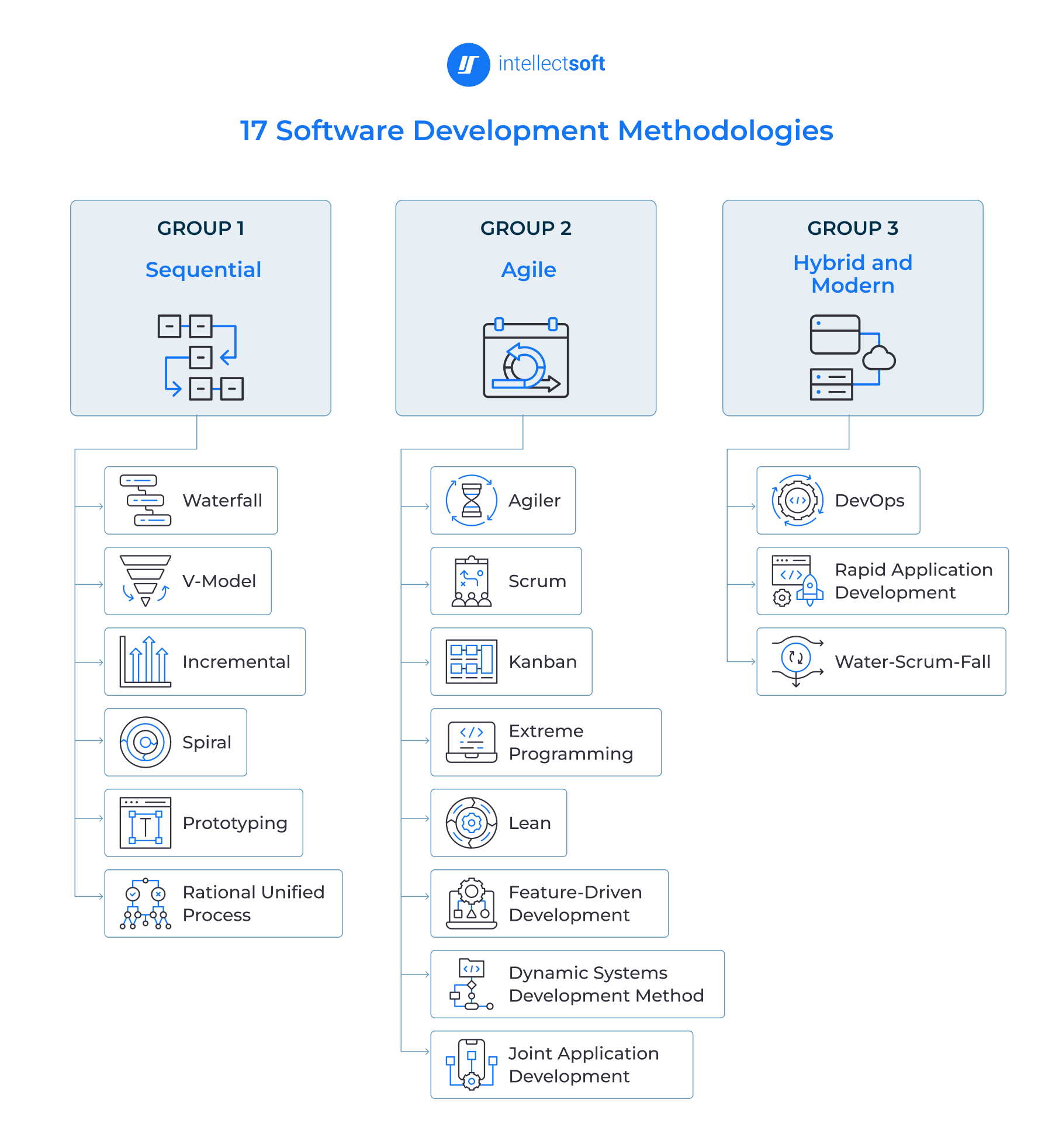
Nothing in this group is obsolete — every model here is still shipping software in industries where a missed requirement carries a regulatory or physical cost.
1. Waterfall Development Methodology
This methodology is strict and linear. A new stage can only be started if the previous one is completed. In other words, each phase gradually flows into the next one. There is no going back to the previous stage. This approach is easy to understand as it presupposes a strict sequence of completed tasks. Waterfall software development methodology is often regarded as a classic representation of software development.
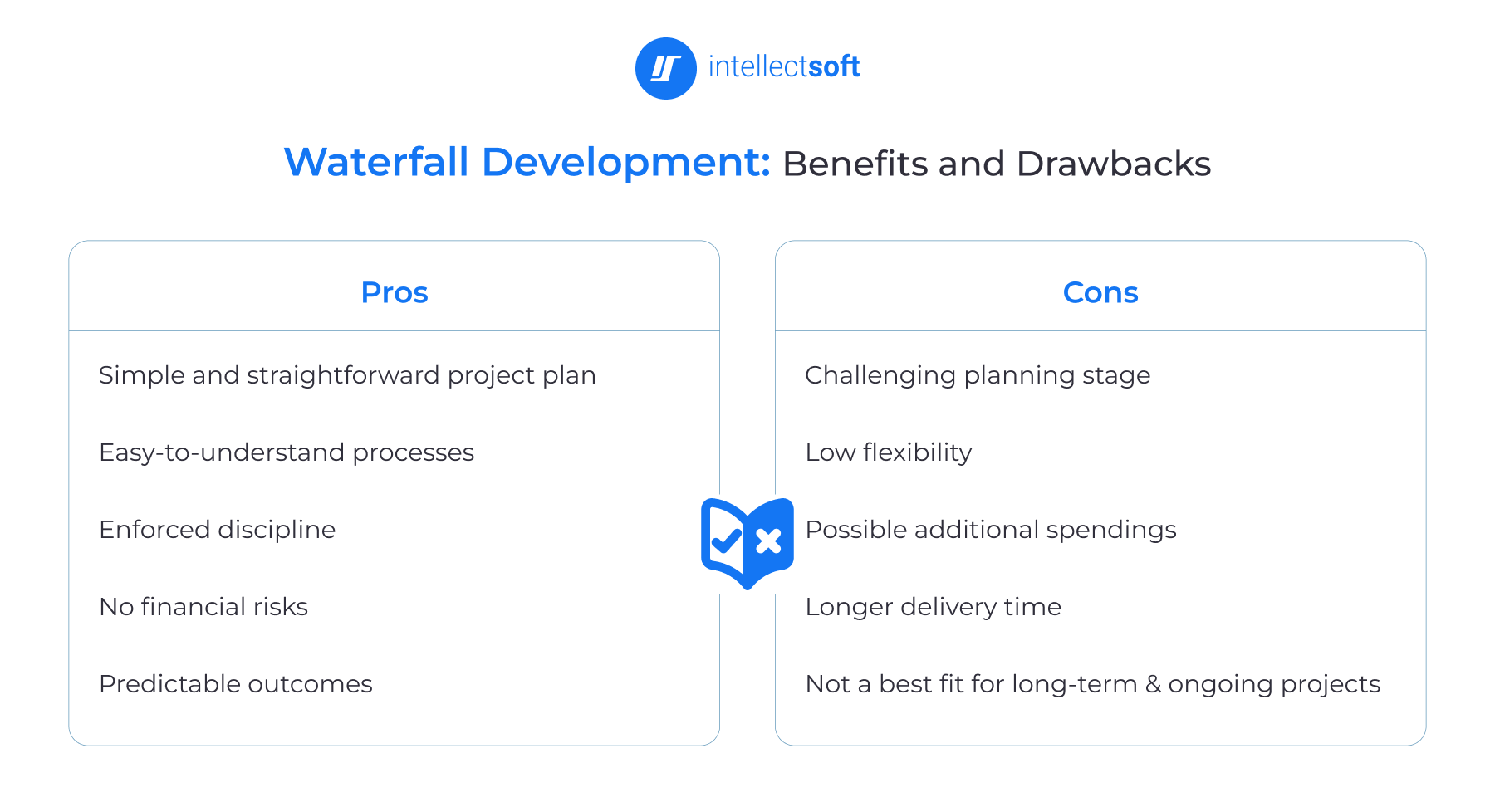
Major Benefits
- The project plan is simple and straightforward, with all the goals, requirements, and important aspects defined before the software development process
- All the processes are easy to understand
- Enforced discipline and better time-keeping
- All the steps of testing scenarios are planned in advance
- No financial risks due to the high planning accuracy
- The outcomes are easy to predict, as they meet all the requirements and criteria outlined in project documentation, so the companies get exactly what they were expected to develop
Possible Drawbacks
- The planning stage can be too challenging to organize the entire process
- Low flexibility and inability to implement changes once the software development process is started
- The immediate changes to the project can result in additional spending that is usually enormously high
- A longer time of delivery
- Weak for long or ongoing projects
Best fit: fixed-scope builds with a signed specification, formal phase sign-off, and a contractual change-order process. For example, government contracts, ERP rollouts against a defined process map, and any program where the scope is set by legislation rather than by users.
2. The V-Model
The V-model extends Waterfall by pairing every development phase with the test phase that will verify it. Requirements are written alongside their acceptance tests; architecture is designed alongside its integration tests. Work descends the left arm of the V through decomposition. Then, it climbs the right arm through verification. That means a defect in the specification is caught by an artifact written at the same time as the specification itself.
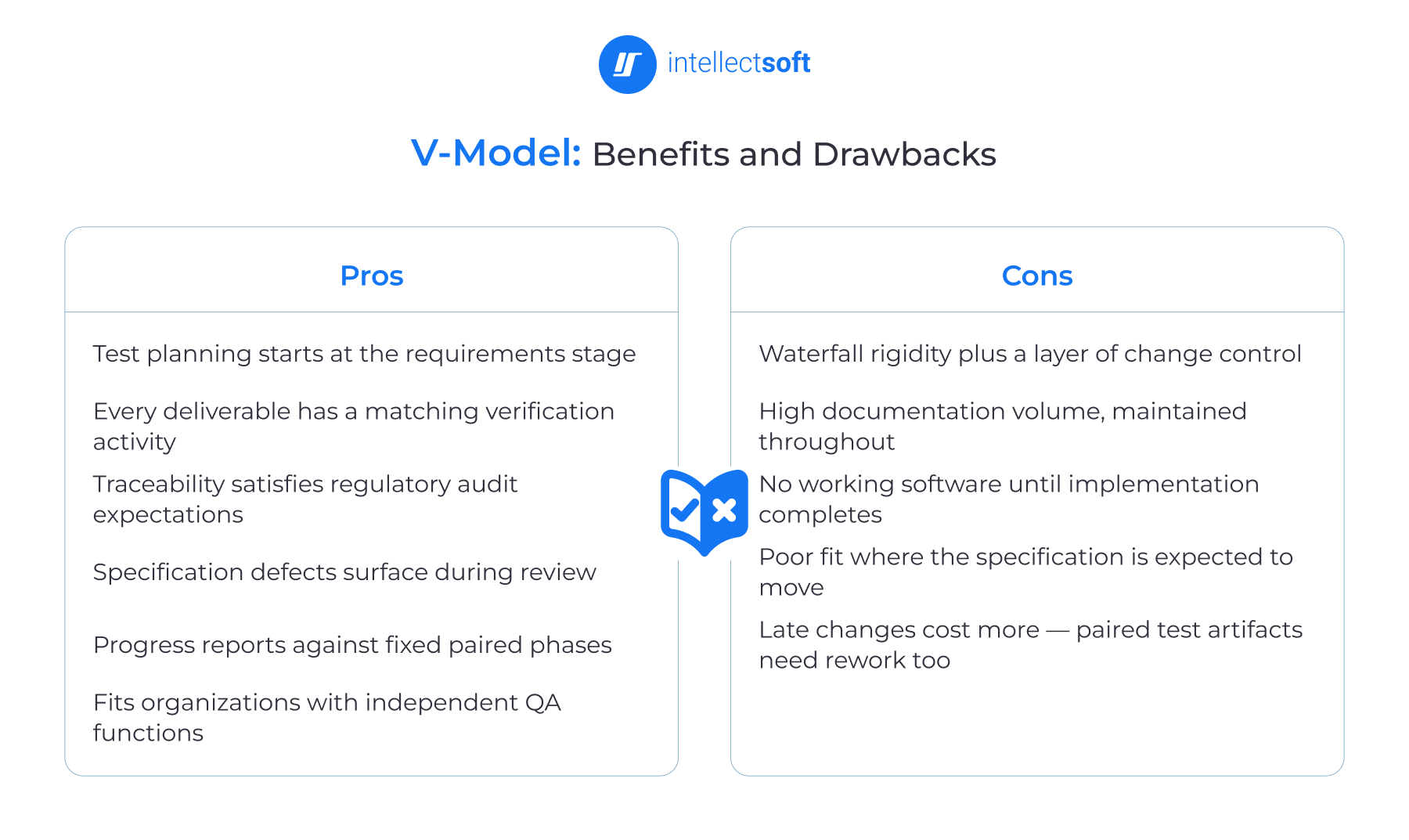
Major Benefits
- Test planning starts at the requirements stage, not after implementation
- Every deliverable has a defined verification activity attached to it
- Traceability between requirements and tests satisfies regulatory audit expectations
- Defects in specification surface during review rather than during system testing
- Progress is easy to report against a fixed set of paired phases
- Suits organizations with a separate, independent QA and software testing function
Possible Drawbacks
- Inherits Waterfall's rigidity, with change control layered on top
- Documentation volume is high and has to be maintained as the build evolves
- No working software exists until the implementation phase completes
- Poor fit where the specification is expected to move
- Cost of a late change is higher than in Waterfall, because paired test artifacts also need rework
Best fit: safety-critical and regulated builds where verification evidence is a deliverable. There are medical device software under IEC 62304, automotive systems under ISO 26262, and avionics work where a certification body reviews the traceability matrix.
3. Incremental Development
Incremental development splits a system into functional increments and delivers them one at a time against a working baseline. The first increment ships a usable subset. Each one after it adds capability to software that already runs. Scope for later increments can be refined while earlier ones are in production. It places this model between the sequential group and the adaptive approaches that follow — the overall plan is fixed, but delivery is staged.
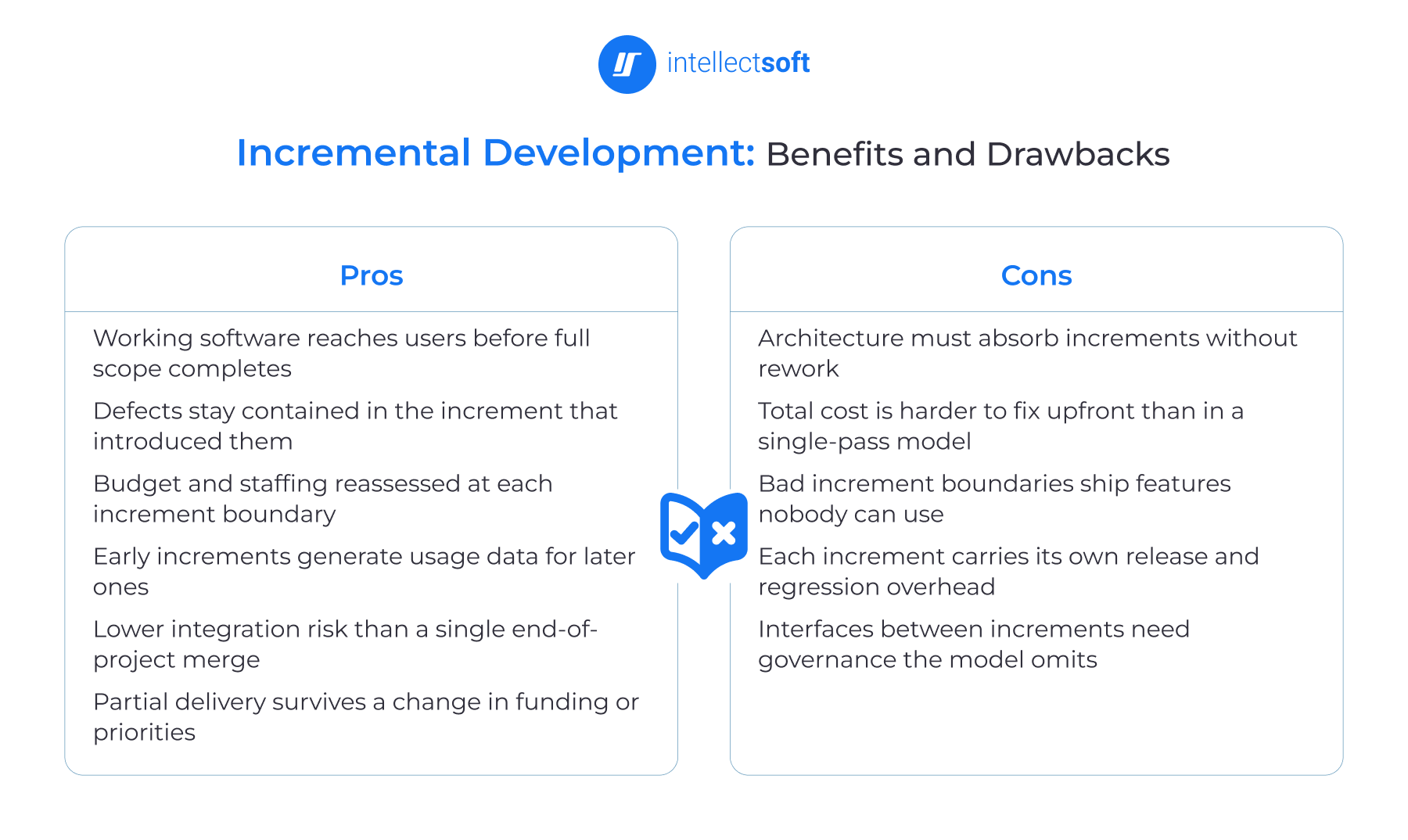
Major Benefits
- Working software reaches users before the full scope is complete
- Defects are contained within the increment that introduced them
- Budget and staffing can be reassessed at each increment boundary
- Early increments generate real usage data that informs later ones
- Reduced integration risk compared with a single end-of-project merge
- Partial delivery is possible if funding or priorities change mid-program
Possible Drawbacks
- Requires architecture capable of absorbing increments without rework
- Total cost is harder to fix up front than in a single-pass model
- Poorly defined increment boundaries produce partial features nobody can use
- Each increment carries its own release, regression, and deployment overhead
- Interfaces between increments need governance the model does not itself provide
Best fit: modernization programs replacing a legacy system module by module, where the old and new platforms have to run side by side and the business cannot absorb a single cutover.
4. Spiral Development Model
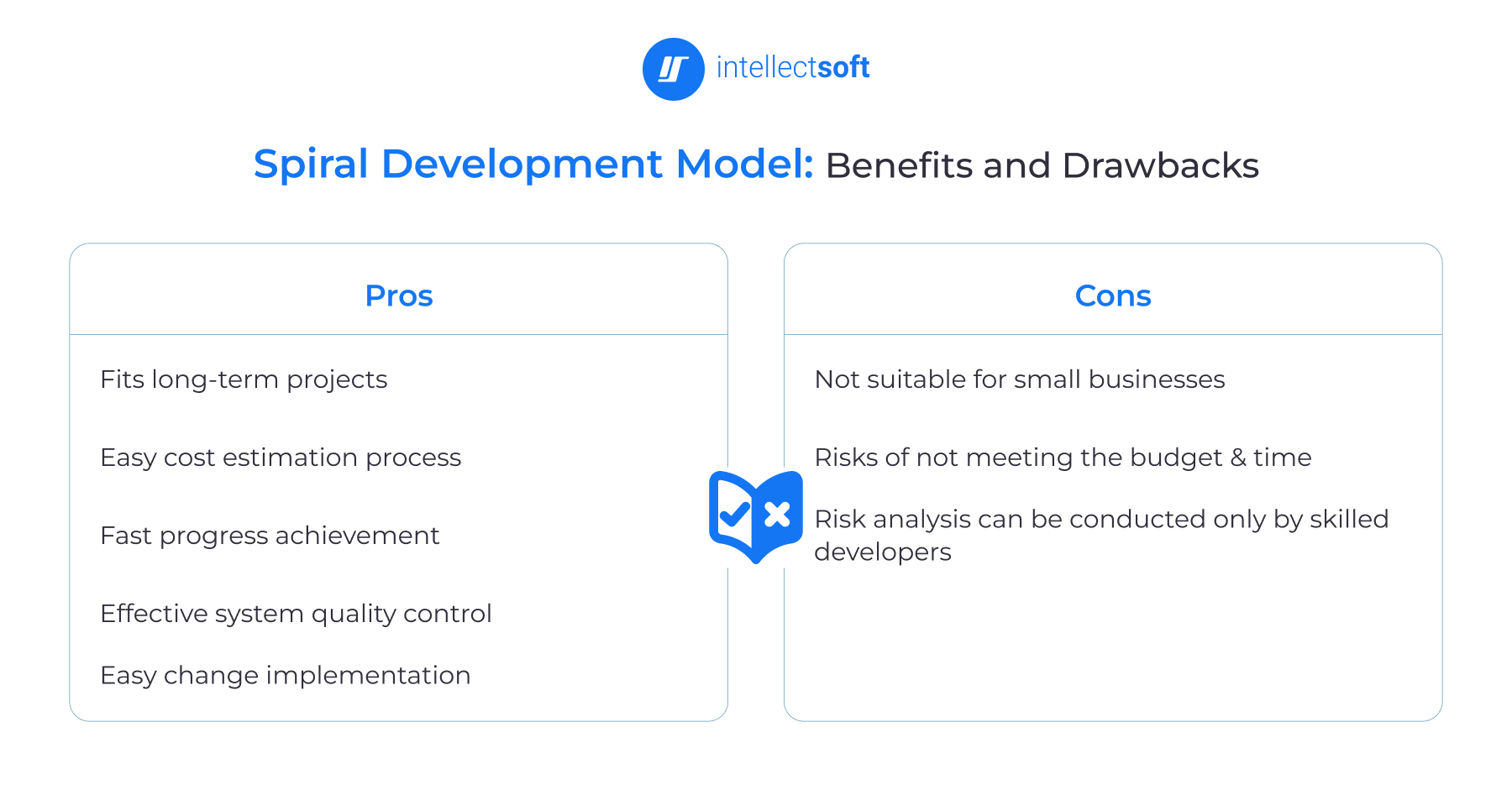
The main idea is to eliminate the risks at the early stage of the project. The developing procedure goes from smaller levels to the big ones gradually. This approach combines waterfall ideas with iterations, and the Spiral model in the SDLC is covered in depth separately. Each stage involves setting goals and receiving feedback from a customer. Moving from one phase to another in a spiral model implies completing and removing the risks before moving forward.
Major Benefits
- Best fits mission-critical and long-term projects which require professional risk analysis and thorough control
- The process of estimating costs is pretty easy yet straightforward
- Features the fast achievement of progress
- Repeated development helps to eliminate the possibility of risks and effectively control the system quality
- The specific functions or changes can be implemented at earlier and later stages
- Leaves a lot of improvement opportunities taken from the customer feedback
Possible Drawbacks
- Not suitable for small organizations and projects
- The danger of failing to meet the agreed budget and time limit
- Requires accurate following of the spiral model project development protocol
- Demands strict risk assessment expertise
- The correct risk analysis can be conducted by experienced developers only
Best fit: large, long-running programs where technical uncertainty is the dominant risk. It can be a first-of-its-kind integration, an unproven platform choice, or a build with a budget large enough to justify a formal risk review at every cycle.
5. Prototyping Methodology
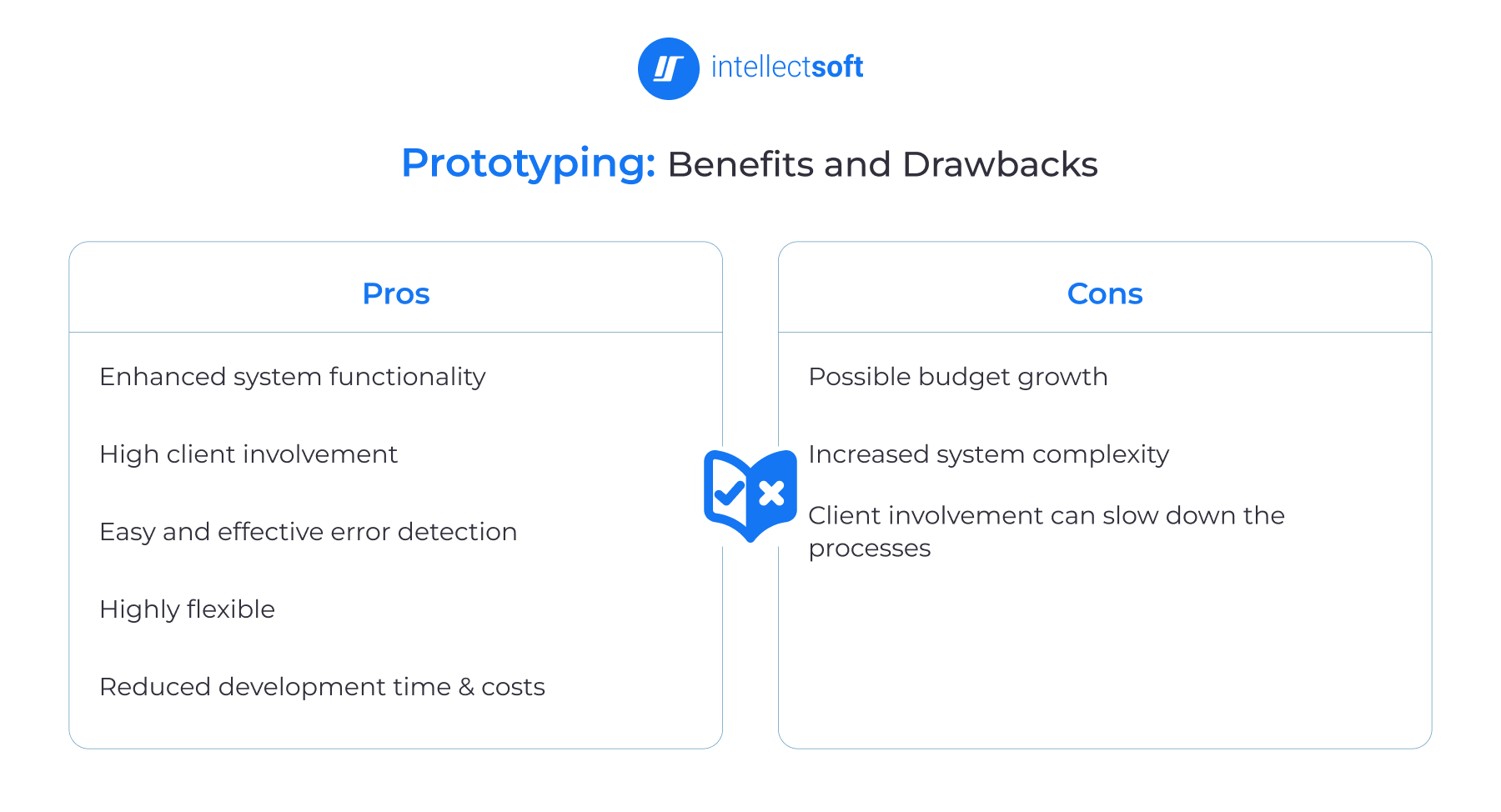
Based on the waterfall approach and having a significant focus on customer feedback. There are some initial requirements; developers provide samples, and only after customers evaluate the functionality of the samples does the final development begin. Before getting down to business, there will be painstaking research and prototyping to avoid unnecessary risks. A throwaway prototype exists to answer a question and is discarded once answered, while an evolutionary prototype is refined into the delivered product.
Major Benefits
- The prototype model can become a great information source for UI/UX improvements
- Enhances the system functionality by analyzing the actual look and feel of the system being developed
- High involvement of customers and final consumers during the development process
- Easier and more effective detection of errors and issues
- High flexibility of the app development process, which enables adding the missing functions or redoing the existing ones
- Reduced time and costs due to the early detection of critical issues
Possible Drawbacks
- Too much customer involvement can affect the process by slowing it down
- Possible budget increase, as the management cost may go beyond the money limit
- An increased complexity system that can enlarge beyond the original plans
- Developers can reuse the existing prototypes that don't always meet the customer expectations instead of creating the new product from scratch
- The risks of the development overdoing with too much effort, time, and costs invested
Best fit: builds where the interface or the workflow is the unknown — a customer-facing application replacing a manual process. Also, it is good for any product whose adoption depends on how it feels to use rather than on what it computes.
6. Rational Unified Process
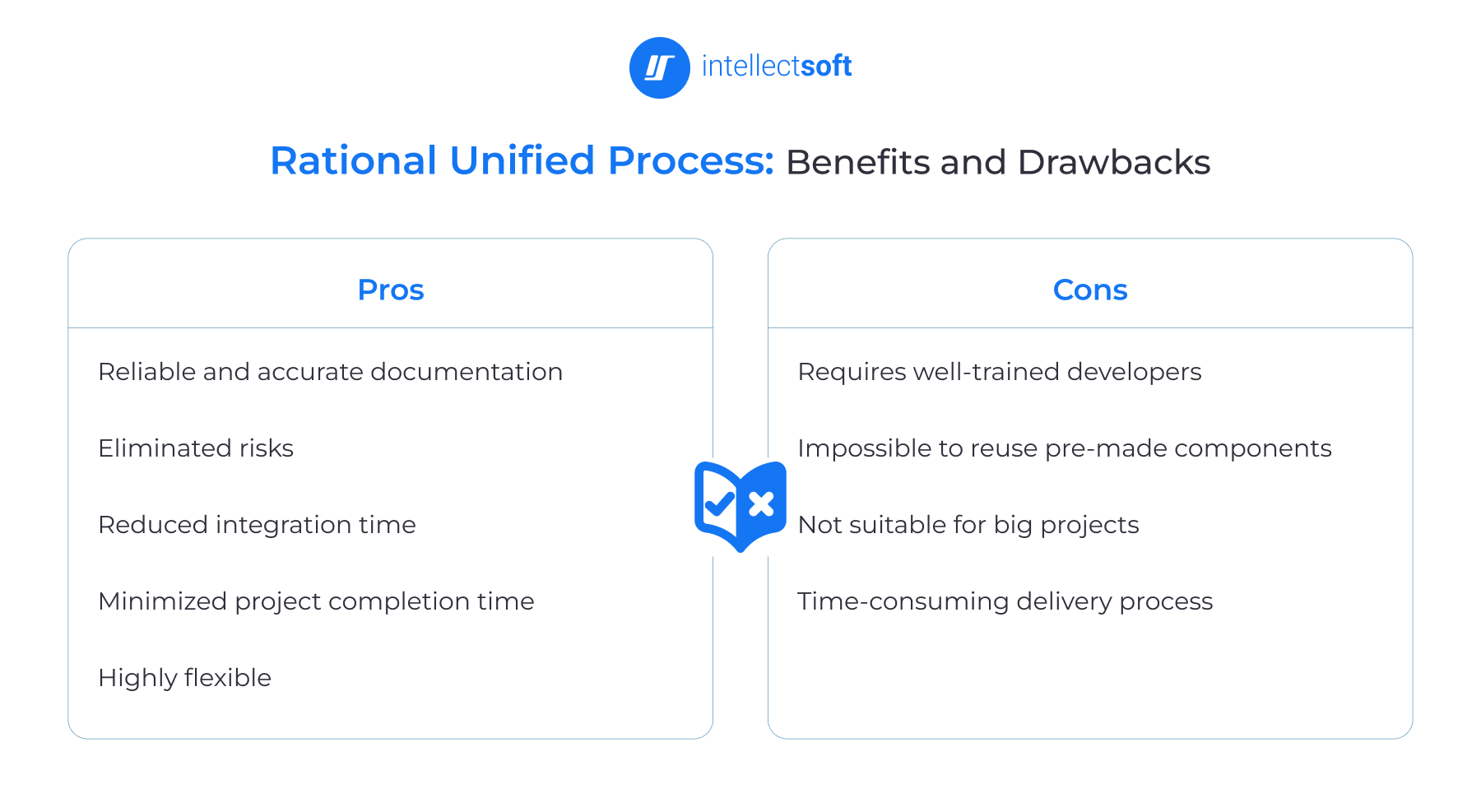
RUP organizes a project into four phases, each ending in a defined milestone. Inception sets scope and business case. Elaboration fixes the architecture and retires the major technical risks. Construction builds the bulk of the system. Transition moves it to users. Six disciplines — business modeling, requirements, analysis and design, implementation, testing, deployment — run across all four phases at varying intensity. So, testing is present during elaboration rather than waiting for a phase of its own.
Major Benefits
- Produces reliable, accurate documentation as a defined output
- Accommodates evolving customer needs across phases
- Less integration effort at the end of the software development life cycle
- Component reuse shortens project completion time
- Widely documented, with training material and tooling available
- Combines Waterfall's discipline with an iterative structure that absorbs change
Possible Drawbacks
- Requires experienced, trained developers to run correctly
- The process itself is complex enough to become a source of confusion
- Heavy on artifacts and process overhead for smaller teams
- Can create difficulty on very large projects spanning multiple development systems, particularly during testing
- Delivery may be too time-consuming for certain project types
Agile approaches
Agile approaches invert the sequencing question. Instead of settling scope before build, they fix the rhythm and let scope move inside it. The benefits of Agile development show up most clearly where the problem is genuinely unknown at the outset. Although it is least clearly where a contract has already fixed what will be delivered.
7. Agile Software Development Methodology
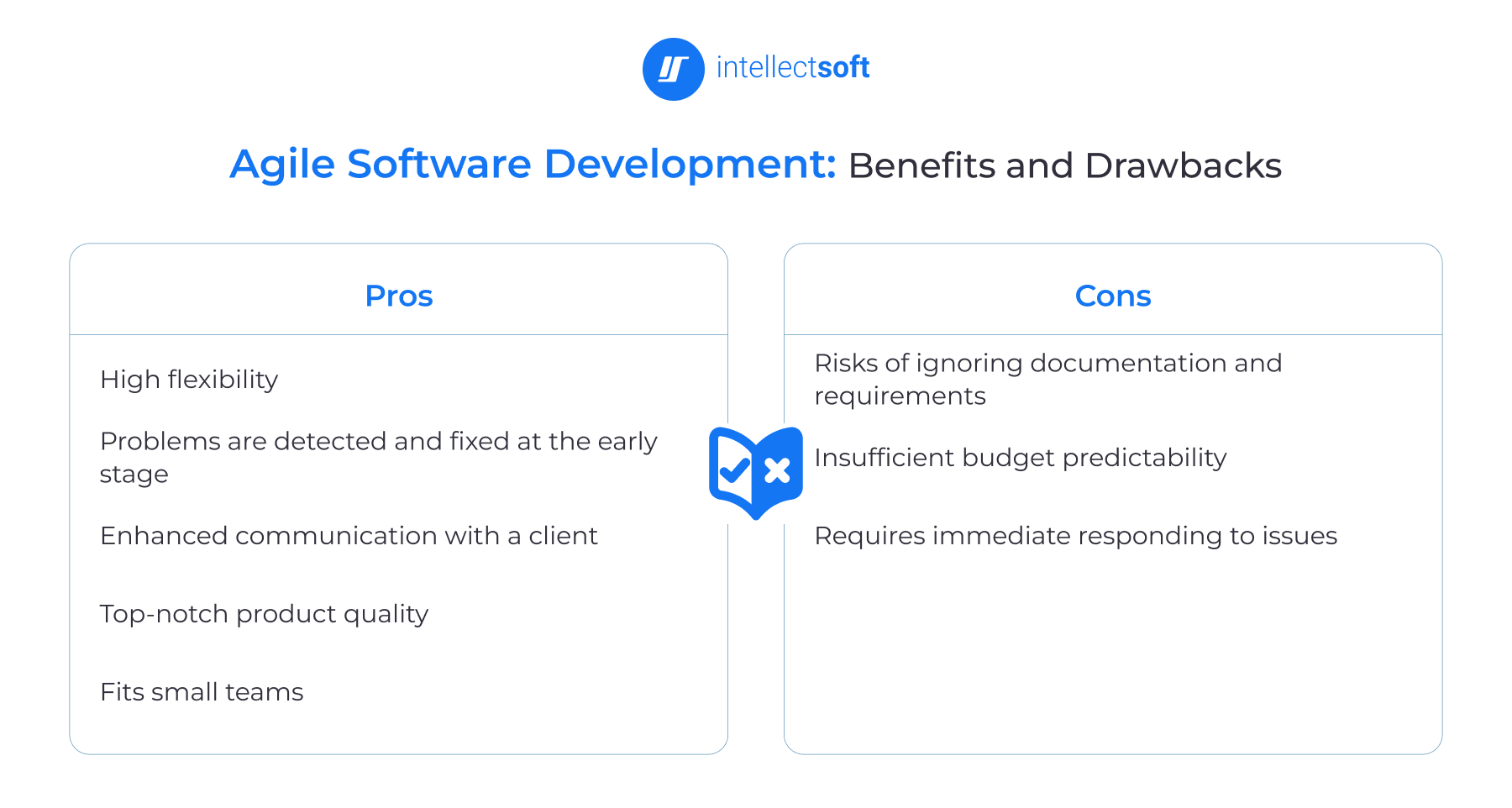
The main focus of this methodology of software development is the project or product itself. It presupposes various constant alterations based on users' and customers' feedback, as well as internal changes related to the work of engineers. Agile is free of rigid frameworks on the one hand. On the other hand, the software development process is divided into short time boxes, thus offering real results and feedback truly fast.
The 2001 Agile Manifesto set four values that everything below inherits. There are individuals and interactions over processes and tools, working software over comprehensive documentation, customer collaboration over contract negotiation, and responding to change over following a plan. Its twelve supporting principles expand those values into working practice — frequent delivery of usable software, direct daily contact between business and engineering, and sustainable pace over crunch. The principles also make technical quality a business concern rather than a team preference, on the argument that good design is what keeps a team able to change direction later.
Major Benefits
- Problems are detected and fixed at an early stage
- Higher flexibility in the plan and easier adaptation to different project changes
- Eliminated time of project deliverables
- Enhanced communication with the customers, and their close engagement at each stage of the software development process
- High quality of the final product
- Mostly fits smaller, young companies that are more flexible and open to active communication
Possible Drawbacks
- Lack of understanding the solution specifics before their implementation
- High risk of ignoring the project documentation and requirements
- Insufficient predictability of the budgeting, marketing plans, sales, and more
- Requires immediate responding to issues and feedback in real-time
- Easy to get lost in details and be pulled off the project course
Best fit: products where the specification is expected to change during the build. For example, new market entries, customer-facing applications with no established usage pattern, and internal tools whose users are available for weekly feedback.
8. Scrum Development
It is easy to understand how the Scrum model works when it comes to achieving results. The working process is divided into sprints. All the assignments for each sprint are set beforehand and are then discussed after this period. Thanks to this approach, it is easy to get a response to emerging problems early.
Three roles carry the framework. The product owner possesses the backlog and governs what’s next on the board. The Scrum master clears impediments and protects the process. The development team owns how we get our work done inside the sprint. The sprint takes shape through four events:
- planning establishes the sprint goal,
- the daily scrum makes blockers visible in fifteen minutes,
- the review shows working software to stakeholders,
- the retrospective changes how the team works before the next sprint starts.
The effectiveness of the Scrum model in practice largely hinges on whether the retrospective leads to tangible changes or generates a list that no one refers to again.
Major Benefits
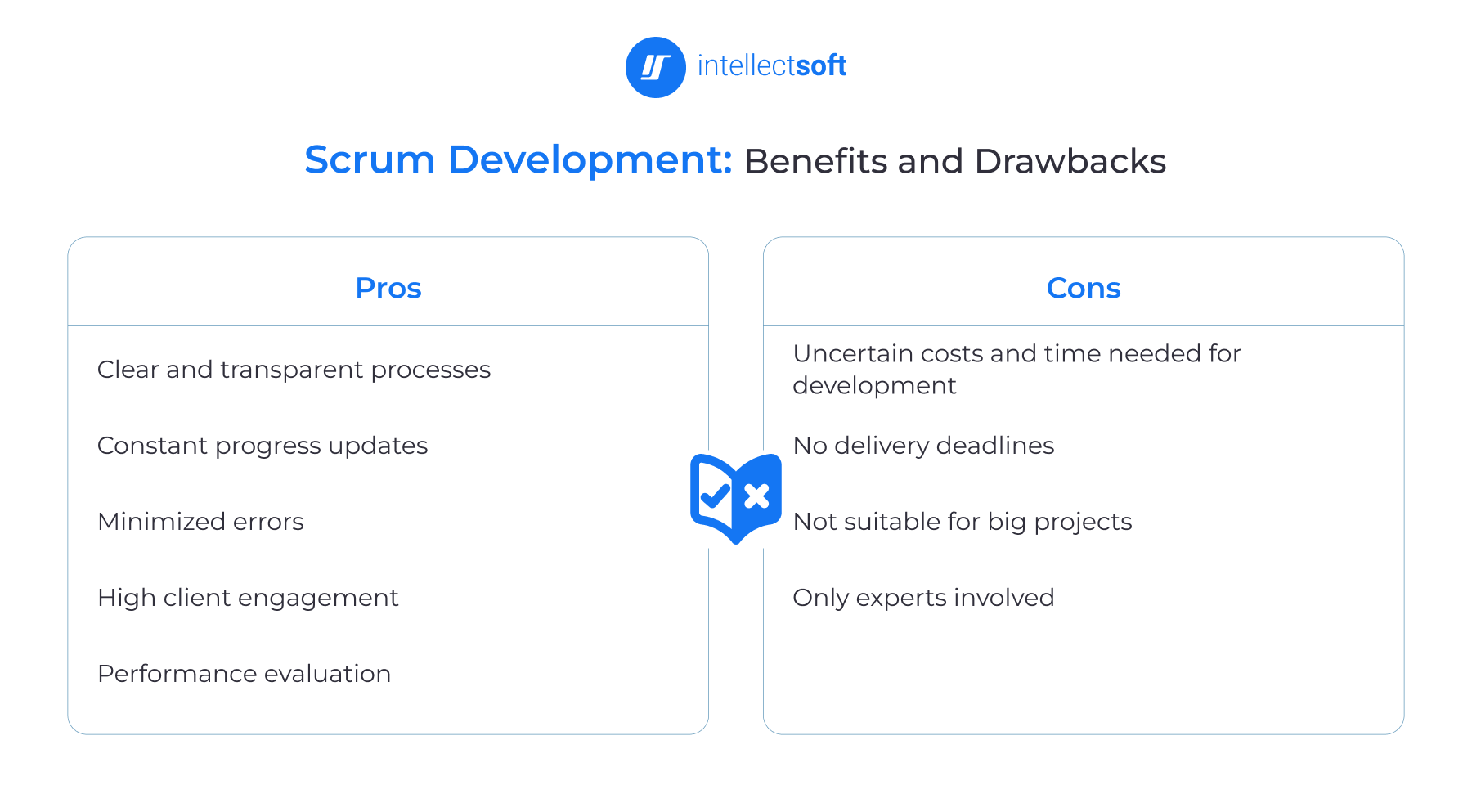
- All the stages and processes are clear and transparent
- Light control goes together with constant updating that keeps all of the team always on guard
- Removing errors and project issues becomes much easier
- Implies high engagement of customers
- Enables frequent updates of the progress, which are proposed at regular meetings
- Customers can trace the various project processes and measure the development performance
Possible Drawbacks
- The costs and time needed can often be uncertain
- No deadlines for the product delivery
- Big projects cannot be managed with this approach
- Only expert professionals who are constantly up to the tasks can be involved, with no beginners
- The test team must conduct regression testing after each sprint, which is one of the most notable difficulties of this methodology
Best fit: cross-functional teams of roughly five to nine people building a product with a single accountable owner and stakeholders willing to attend a review every two weeks.
9. Kanban
Kanban does not focus on iterations. Effort is illustrated on a board which represents the real stages that a job will go through, and each stage is limited by how many items can be in it at the same time. When a limit is hit, nobody starts working on something new or, generally, adds to the work already being done. Everybody must finish what is already open before pulling anything else. The delivery is continuous, and flow metrics such as cycle time from start to done, throughput per week, and a cumulative flow diagram, which makes any growing queue visible before anyone calls blocking, are used to measure progress.
Major Benefits
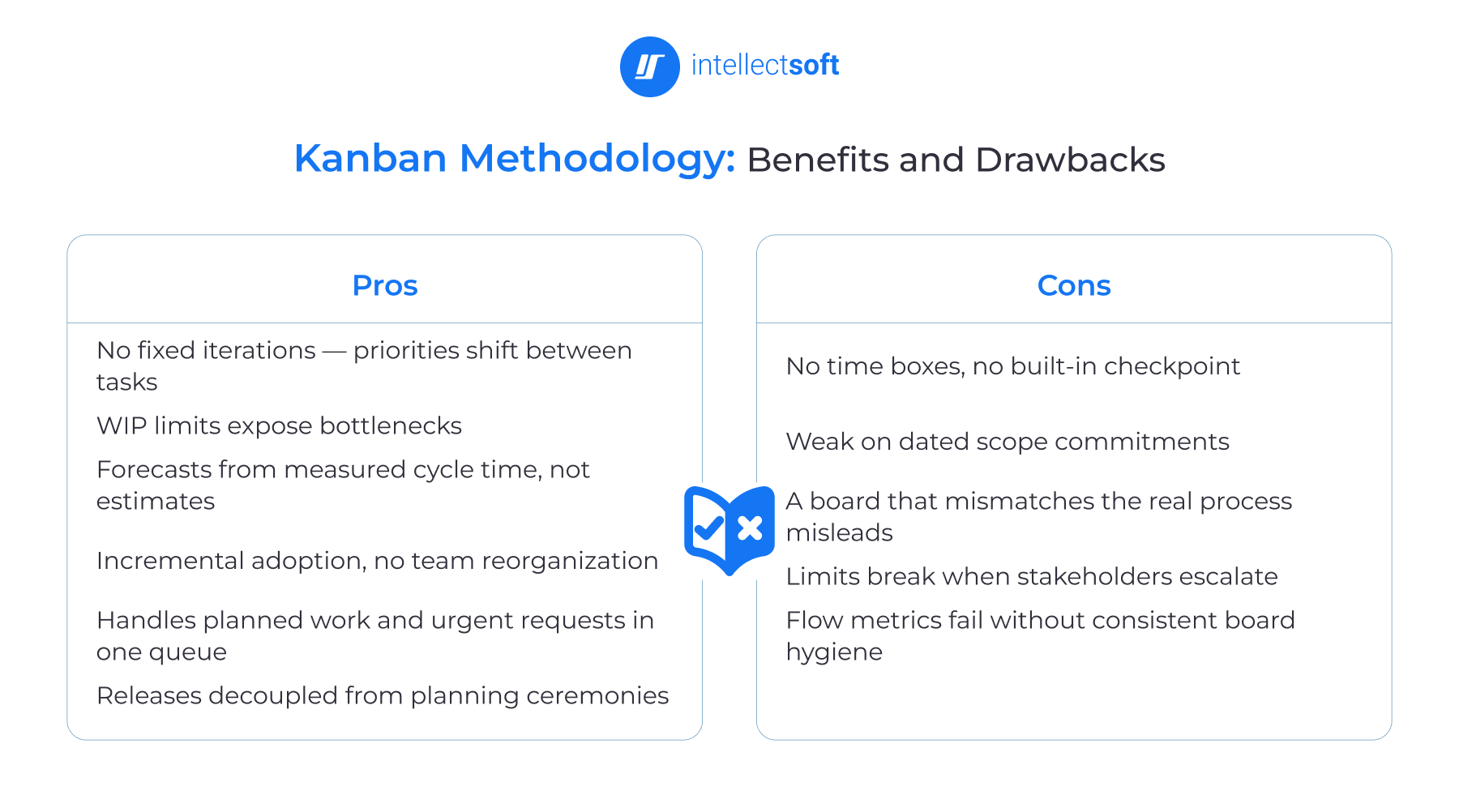
- No fixed iterations so that priorities can change between one task and the next
- Work-in-progress limits expose bottlenecks instead of hiding them behind busy people
- Cycle time and throughput give a forecast based on measured history, not estimates
- Adoption is incremental — the board can map an existing process without reorganizing the team
- Suits mixed intake where planned work and urgent requests share the same queue
- Release cadence is decoupled from a planning ceremony
Possible Drawbacks
- Absence of time boxes removes the natural checkpoint a sprint provides
- Weak on long-range planning and on committing to a dated scope
- A board that does not match the real process gives false confidence
- Requires discipline to respect limits when a stakeholder escalates
- Flow metrics need consistent data to mean anything, and inconsistent board hygiene destroys them
Best fit: support and maintenance teams, platform and infrastructure work with unpredictable intake. It is also suitable for any team that practices continuous delivery where releases are decoupled from planning cycles.
10. Extreme Programming Method
One of the software development approaches suitable for unstable projects. It implies engaging with the customer as much as possible. Also, it presupposes considerable flexibility. Extreme programming methodology is believed to boost the quality of software owing to its ability to adapt to dynamically changing demands. Constant feedback and communication are the key to an efficient and happy team environment.
Two practices define XP more than any others. Pair programming involves two developers collaborating at a single workstation. One developer writes the code while the other one simultaneously reviews what they do. This makes it so that code review becomes something continuous rather than a gate at the end. Test-driven development reverses the order of «add function and its tests» by writing the failing test first, then the code to pass it, then the cleanup. The outcome is a suite that adapts to the system’s evolution and a design that is determined by the method of invocation.
Major Benefits
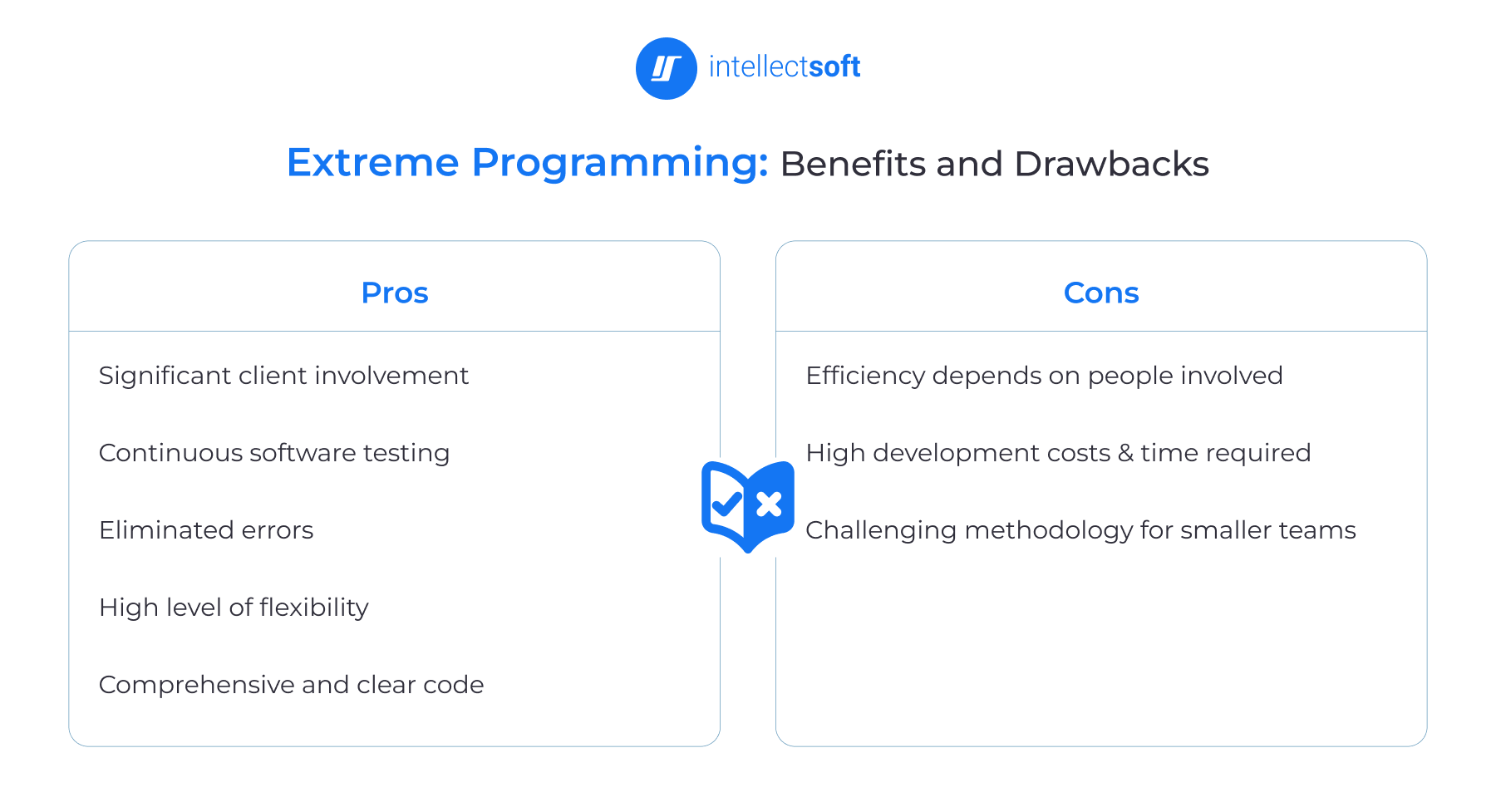
- Significant customer involvement results in high-quality products
- Stable final product due to continuous software testing
- Pair programming eliminates the errors that may occur during the software development process
- High level of flexibility and the ability to immediately implement the changes
- Code stays clear and comprehensive
- No rush to keep the timelines — developers work at their own pace
Possible Drawbacks
- Efficiency is much dependent on the people involved
- Vague and unknown future results
- Customers must always be engaged in the software development process
- Comparatively large time and high costs of investments
- It is too challenging for the small teams, as they might not possess all the necessary skills and knowledge
Best fit: small co-located or well-connected teams working on code they will maintain for years, with a customer representative available daily.
11. Lean Development
Value for the customer is the essential core element the whole approach revolves around. If something is worth it, it should be done immediately; if not, it should be removed. Lean focuses a lot on loss reduction, so the whole project is examined significantly beforehand to eliminate any wasted time or money. As value is the core component, feedback plays a crucial role itself, so that the actions are taken fast.
Major Benefits
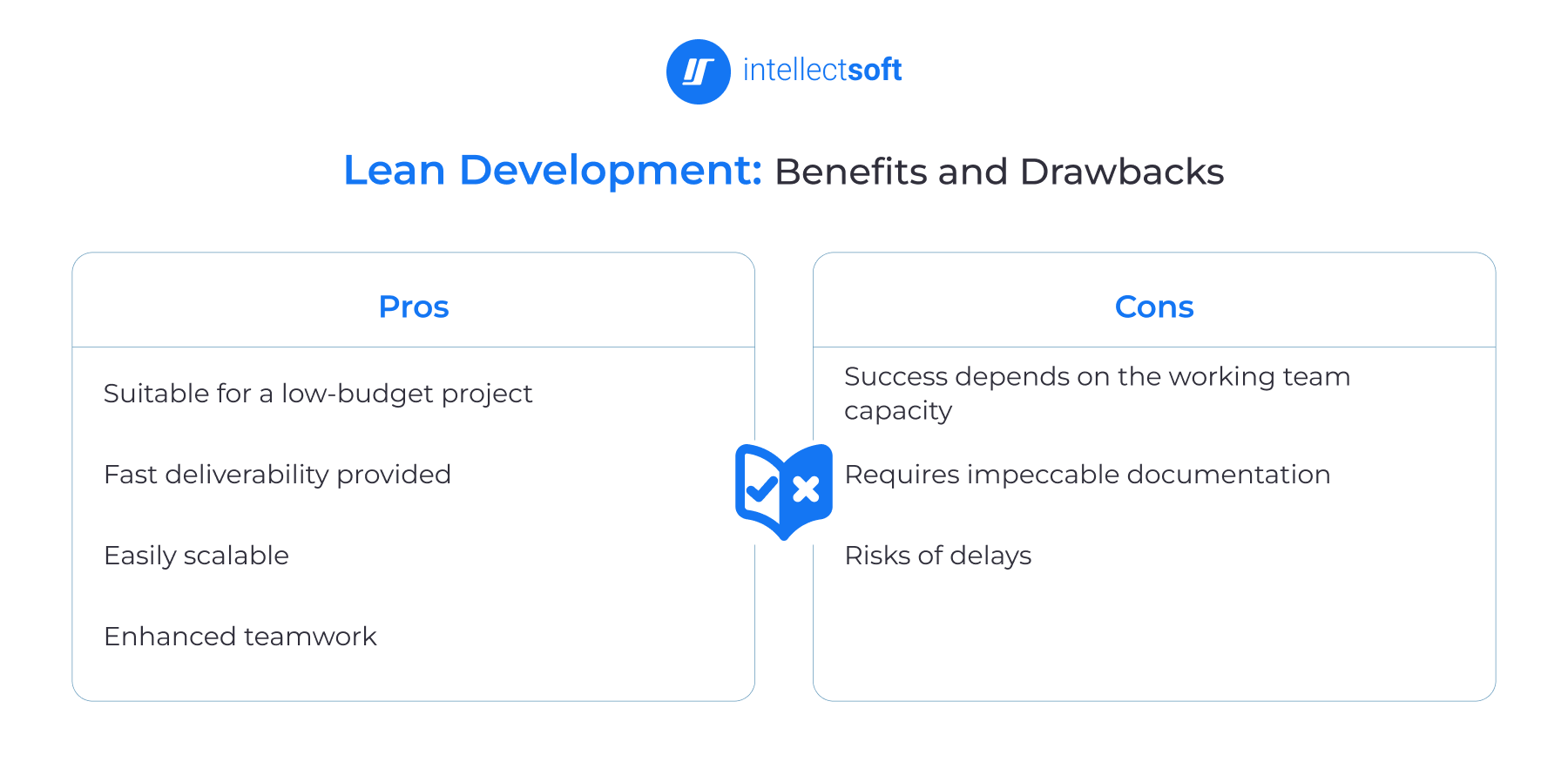
- Perfect for a low-budget project and rigid time limitations
- The team is focused on delivering on-demand tasks
- Provides fast deliverability by eliminating waste and useless processes
- Is easily scalable — ideally suited for large projects, unlike most of the other software development methodologies
- Cutting out tasks allows getting more time for the core processes and implementing the high-value features in the final product
- Enhanced teamwork enables focusing on meaningful and impactful work with a greater sense of purpose
Possible Drawbacks
- Success is much dependent on the working capacity of a team
- Low experience and lack of expertise might not work if the team works independently
- Cutting too many things can lead to a loss of project focus
- Risks of delays due to certain bottlenecks or low resource levels
- Requires excellent documentation to make sure all the aspects are developed correctly
Best fit: organizations with a mandate to cut delivery waste and the authority to remove process steps, particularly where an existing workflow has accumulated approvals nobody can justify.
12. Feature Driven Development
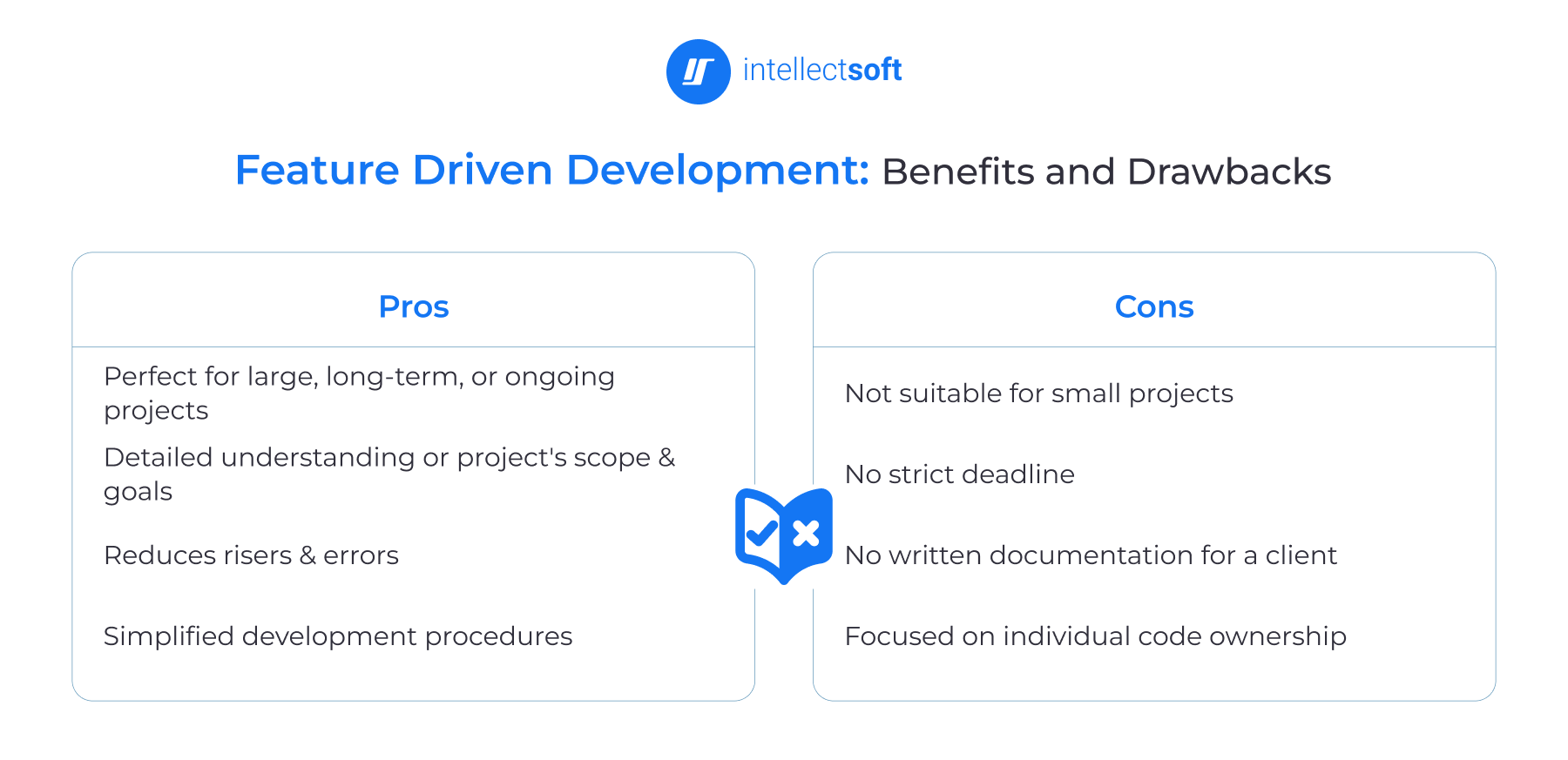
Features are regarded as a sort of user feedback. Planning, designing, and building are all feature-based. This approach involves iterations to boost functionality and deal with varied complexities. Feature-driven development aims at organizing the work of a large number of teams within a big organization. Each feature is scoped to be built within two weeks; anything larger is decomposed until it fits.
Major Benefits
- Mostly fits large-scale, long-term, and ongoing projects
- Provides a detailed understanding of the project's scope, major goals, and context
- Breaks the feature sets into smaller chunks and regular iterative releases, thus reducing the risks of errors and enabling the delivery of specific features in shorter time frames
- Uses the pre-set standards to simplify the development process
- Enables any developer with appropriate experience and expertise to handle the tasks
- Based on a user-centric approach, where the outcome depends on the user's opinion
Possible Drawbacks
- Cannot be applied by small organizations and for smaller projects
- Requires several experienced developers to monitor the process
- Difficult to guarantee a strict deadline
- Doesn't provide the written documentation for the customers, only the communication among the developers during the project launch cycle
- Is more focused on individual code ownership instead of the shared team model
Best fit: large programs running several teams against one shared domain model, where a feature list can be enumerated up front.
13. Dynamic Systems Development Method
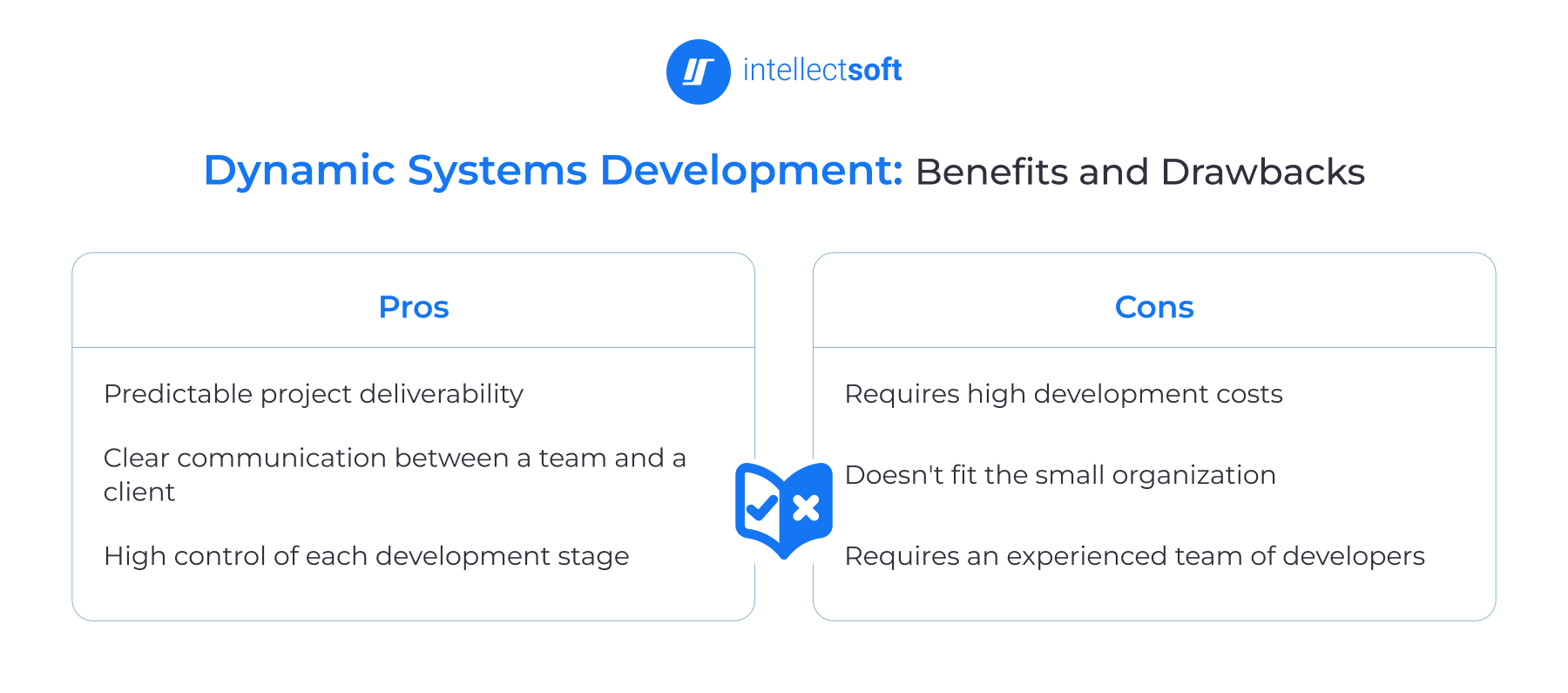
There are two main focuses: a strict time frame and an assigned budget. The idea is to manage to provide successful and effective software within a particular time limit and not exceed costs. Users' involvement is of high importance as well. DSDM presupposes continuous feedback to deliver maximum functionality within the agreed requirements. Scope is controlled through MoSCoW prioritization. It sorts every item into must have, should have, could have, and will not have this time. Time-boxing then fixes the schedule and lets the lower categories fall out when the box runs short. So, the deadline holds and the content flexes.
Major Benefits
- Time-boxed yet predictable project deliverability
- Developing processes are delivered at a standard level of quality, which can be improved through the analysis of documentation, software testing, and periodic review of the outcomes
- Great communication between developers and customers
- Reaching the needed functionality as fast as possible
- Producing enough design work upfront (EDUF) to get a more concrete idea of what product the customer needs
- High control under each stage of the project development
Possible Drawbacks
- Requires considerable costs for development
- The approach will not fit and meet the needs of a small organization
- Doesn't stimulate the developer's creativity
- Projects are mainly focused on complying with the documentation and standards, which can neglect some of the more sophisticated options available
- Requires an experienced team of developers with deep expertise in both business and technical aspects
Best fit: fixed-date, fixed-budget programs where the delivery date is externally imposed, and the business accepts that lower-priority scope will be dropped to hold it.
14. Joint Application Development
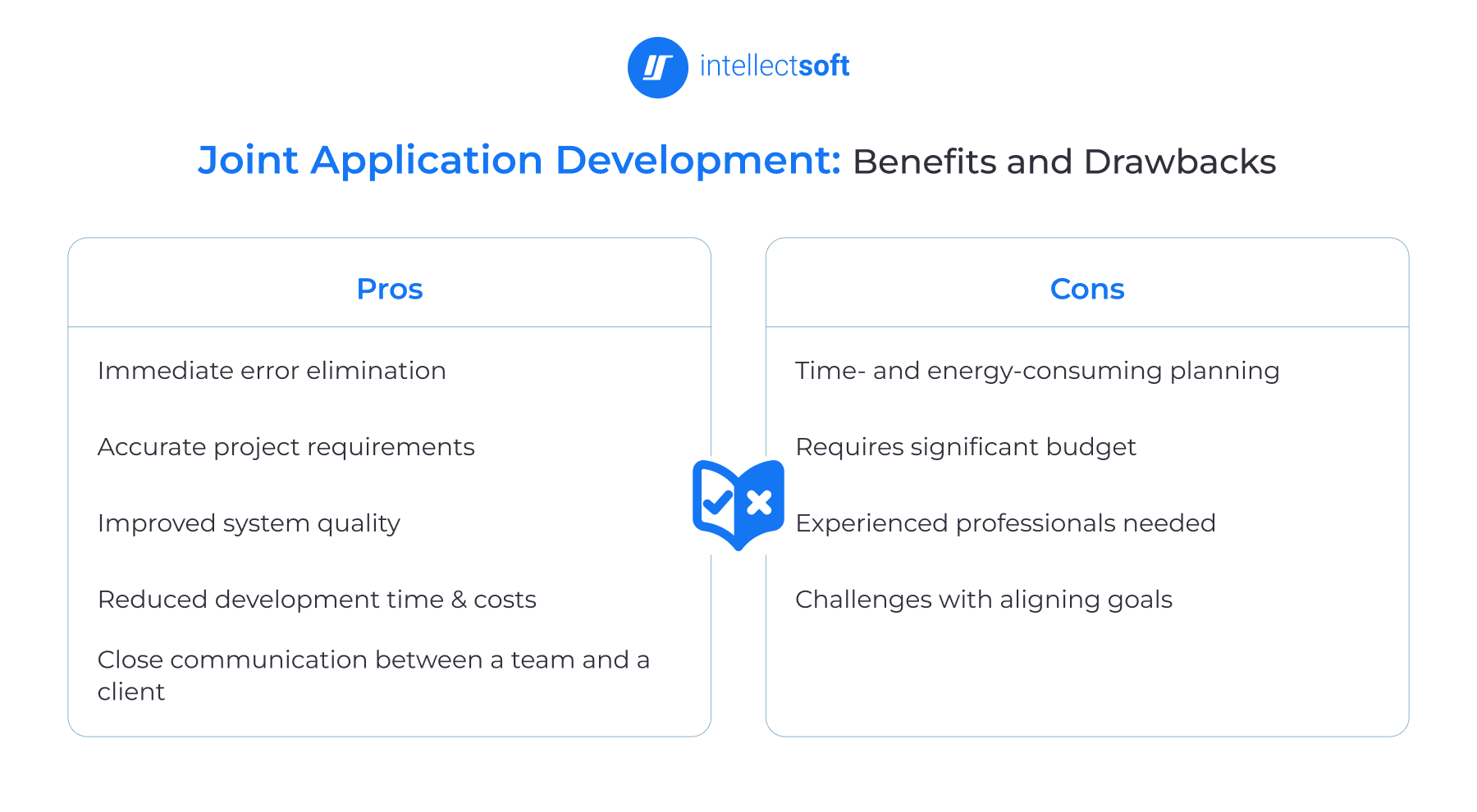
JAD runs requirements gathering as structured workshops instead of interviews. A facilitator convenes end users, developers, observers, mediators, and subject-matter experts in one room. Decisions are made in session rather than circulated afterwards. The focus is on eliminating errors at the early stage, when correcting them is still cheap.
Major Benefits
- Valuable information is achieved within a short period
- Immediate elimination of errors and resolving the differences, which greatly boosts the software quality
- Reduces the time and costs needed for the project development
Possible Drawbacks
- Can be quite a time- and energy-consuming model when it comes to planning
- Requires significant budget for the project launch
- Depending on the project size, it can be more difficult to align goals and maintain the overall project picture
Best fit: requirements-heavy projects with many competing stakeholder groups. The cost of scheduling a multi-day workshop is lower than the cost of reconciling contradictory written input.
Hybrid and modern delivery models
Hybrid and modern delivery models combine what the first two groups keep separate. Some of the different software development methodologies below are not methodologies in the strict sense at all. They are operating models or delivery patterns that sit alongside one, which is exactly why they appear last.
15. DevOps
By combining development (Dev) and operations (Ops), the two create value while eliminating handoffs. Each team is responsible for a service from development through production incident, which changes what «done» means. A feature isn’t done when it merges; it’s done when it performs reliably under real load. Automation is the default rather than an optimization.
Most of the value is derived from only four activities. Development teams use continuous integration (CI) to manage code repositories in which individual programmers upload their changes for testing.
- The first stage implies that after each check-in, the CI tool builds the code under test to ensure that nothing is broken.
- The second activity is continuous delivery, which ensures all builds are shippable and creates an engineering event that must make a business decision.
- Infrastructure as code is the third activity, which means servers, networks, and any other infrastructure elements are treated as software in version control rather than stored in a local repository.
- The fourth step is failure, and you want to capture logs, metrics, and traces needed for post-mortem analysis, which may generate millions of lines of code needed for debugging.
DevOps is not a replacement for Agile. Instead, Agile determines what teams do, while DevOps dictates how these objectives are achieved. A team can run Scrum sprints with a manual quarterly release, or continuous deployment against a Kanban board — the two decisions are independent.
DevSecOps works similarly to the security field. Rather than a penetration test before deployment, the security testing happens as part of the pipeline during every commit. It uncovers potentially vulnerable libraries at the point of their introduction in the code.
Major Benefits
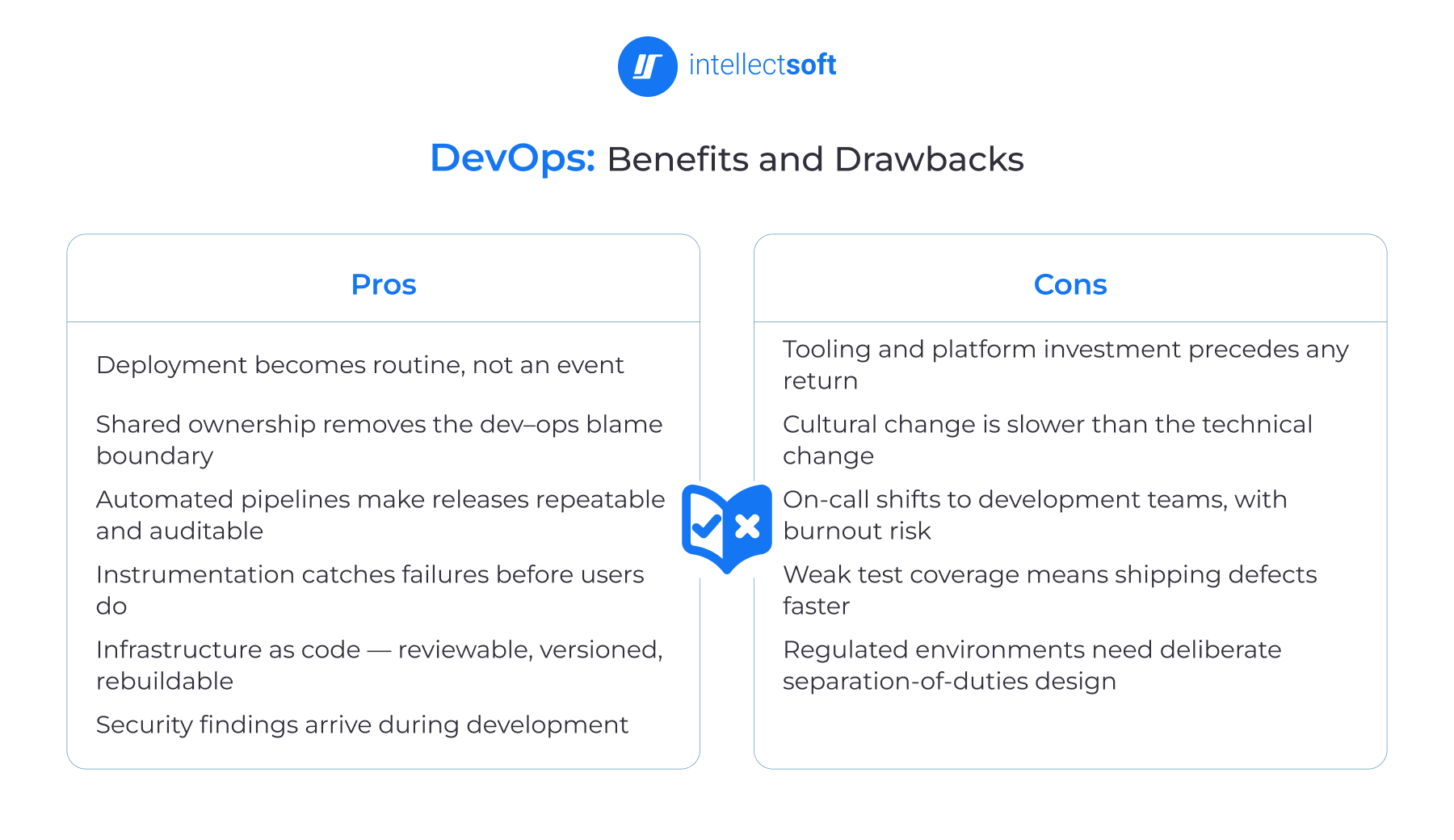
- Deployment becomes routine rather than an event requiring a change window
- Shared ownership removes the blame boundary between development and operations
- Automated pipelines make the release process repeatable and auditable
- Failures are detected by instrumentation instead of by users
- Infrastructure defined as code can be reviewed, versioned, and rebuilt on demand
- Security findings arrive during development, when fixing them is cheapest
Possible Drawbacks
- Requires real investment in tooling and platform engineering before returns appear
- Cultural change is harder than the technical change and takes longer
- On-call responsibility shifts onto development teams, with burnout risk if unmanaged
- Poor test coverage makes rapid deployment a way to ship defects faster
- Regulated environments need deliberate design to satisfy separation-of-duties requirements
Best fit: teams running their own services in production with an existing automated test suite, particularly SaaS products where release frequency is a competitive constraint.
16. Rapid Application Development
It is clear from its name that the main goal of this approach is to achieve fast results. To do so, it uses the assistance of other development methodologies. It focuses on fast prototype releases and iterations. Quick feedback is received, errors are eliminated, and the desired results are reached. It is as flexible and adaptable as possible. The main focus is to adjust so that the software is crafted, functional, and effective quickly. Rapid application development methodology includes five stages: analysis and quick design, prototype cycles, testing, and implementation. The same compression logic drives MVP development, where the goal is a working product in front of users before the full feature set exists.
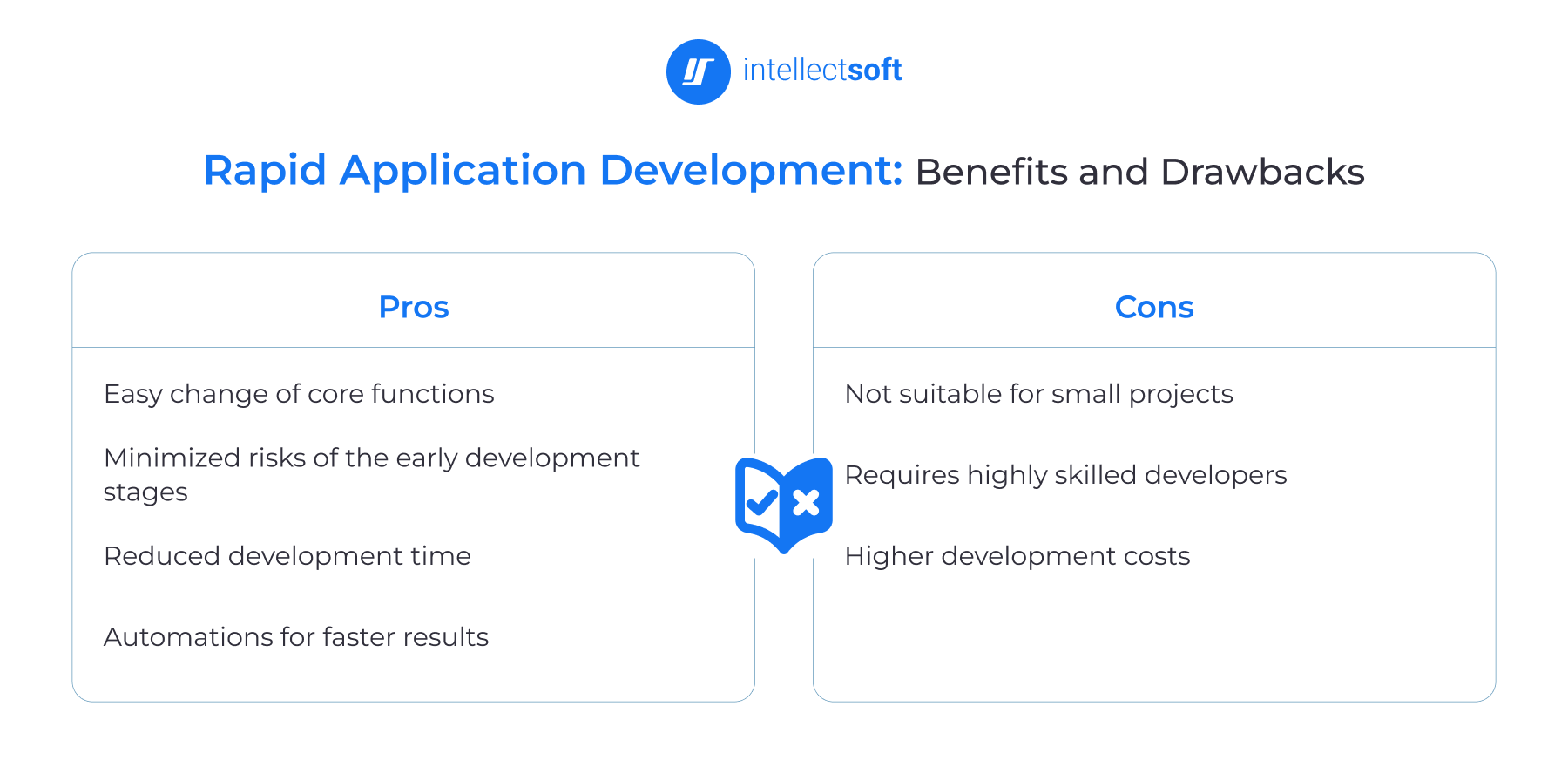
Major Benefits
- The customer is encouraged to provide fast reviews and constant feedback for improvements
- Enables easy change of the core functions when the software is in the testing phase
- Minimizes the risks since the early stages of development
- Reduces the time of development by setting the deadlines for the project completion
- Is mainly focused on delivering the business problems important for the end-users
- Applies the use of automated tools that allow creating prototypes more easily and much quicker
Possible Drawbacks
- Not suitable for small projects
- Requires highly expert developers and a strong collaboration between the teams
- The stages are not strictly defined, which impacts the overall project structure
- The development costs are comparatively high
- All the requirements should be outlined before the development process starts
Best fit: time-boxed builds with an engaged business sponsor and a toolchain that enables rapid assembly — internal applications, line-of-business systems, and validation builds.
17. Water-Scrum-Fall and Other Hybrid Patterns
Water-Scrum-Fall describes what many organizations actually run once the label is removed. Planning, budgeting, and architecture happen sequentially and upfront. Development then runs in sprints. Release management reverts to sequential control, with a change advisory board, a scheduled release window, and formal sign-off. Sprints sit inside a waterfall shell.
The pattern gets criticized as a failure to commit, and sometimes it is. It also survives because the constraints producing it are real: annual capital budgeting, procurement cycles, regulated release approval, and platform dependencies that cannot deploy on a team's schedule. A hospital system running two-week sprints still cannot deploy to a clinical environment without a validation cycle.
But the failure mode is not the hybrid itself. It is running one without acknowledging it. So, a team commits to sprint goals while its release dates are set by a plan written eleven months earlier.
Other hybrid patterns follow the same principle of splitting governance from execution. Sequential phase gates can wrap iterative delivery for large capital programs. A regulated product can run Agile for feature work and the V-model for the safety-critical subsystem that needs a traceability matrix.
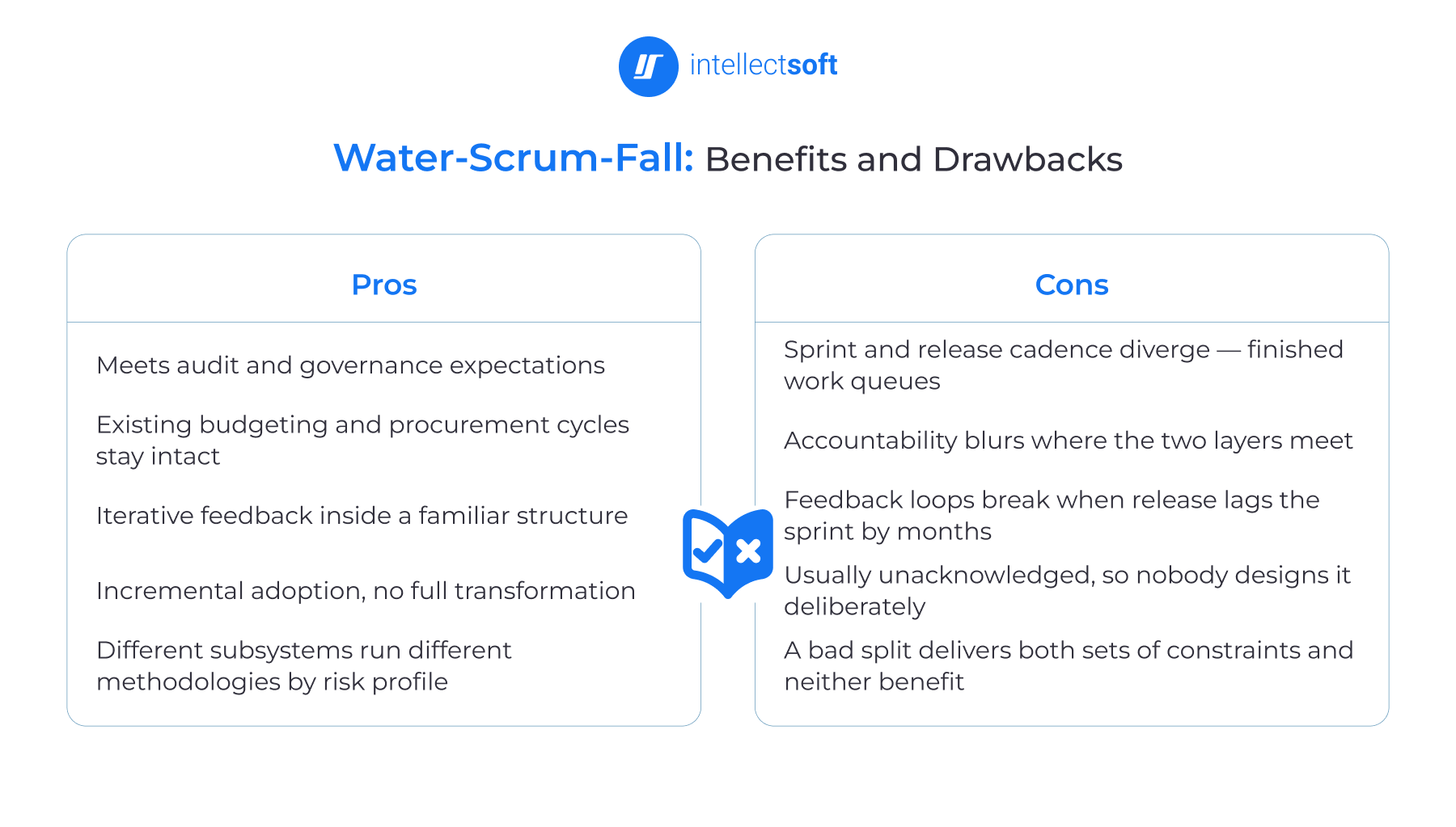
Major Benefits
- Satisfies governance and audit expectations without forcing sequential development
- Existing budgeting and procurement cycles stay intact
- Teams gain iterative feedback inside a structure the organization already understands
- Adoption is incremental, with no all-at-once transformation required
- Different subsystems can run different methodologies according to their risk profile
Possible Drawbacks
- Sprint cadence and release cadence diverge, so finished work waits in a queue
- Accountability blurs where the sequential and iterative layers meet
- Feedback loops break when a release window is months after the sprint that produced the work
- Frequently unacknowledged, which prevents anyone from designing it deliberately
- Teams experience the constraints of both approaches and the benefits of neither when the split is drawn badly
Best fit: regulated organizations and platform modernization programs where release approval, budgeting, or compliance validation sits outside the team's control.
Scaling Agile Across Multiple Teams
Scrum was designed for one team of five to nine people. Nothing in it says what happens when eleven teams share a codebase and a release date. The scaling approaches below answer that question differently, and the choice between them is mostly a choice about how much coordination structure an organization is willing to impose.
One caution before the numbers. The adoption numbers for the various frameworks are based on very limited questioning of self-selected respondents and are highly volatile from edition to edition, reflecting more on quirks of language than any objective reality.
Scrum of Scrums
Scrum of Scrums is by far the oldest and simplest method, which is appropriate enough given that it’s really just a supplement to Scrum. Each team sends a single representative to a cross-team daily standup, where they review what their team has done and what they intend to do. A comparative study of Agile scaling approaches notes that the practice builds on the daily Scrum held every 24 hours inside each team and is recommended for settings with up to ten teams, with multiple levels stacked for larger scales. Dependency management is the whole point — the meeting exists to surface the collision before it becomes a merge conflict or a blocked release.
The practice sits at the core of Scrum@Scale. It adds scaled retrospectives, a Scrum master to facilitate the cross-team meeting, and a dedicated team for removing impediments. Survey evidence puts Scrum of Scrums ahead of the heavier frameworks in raw usage. An empirical study of organizational agility initiatives recorded it as the most frequently deployed scaling framework among respondents, ahead of lean management, internally created methods, SAFe, and LeSS.
Best fit: three to ten teams with existing Scrum maturity, where dependencies are real but the organization does not need a portfolio-level planning structure.
Large-Scale Scrum
LeSS scales Scrum by refusing to add much. All teams in the scrum of scrums have synchronized sprints, and they plan to release a unified increment of value to stakeholders at the end of each sprint. The combined teams share a common backlog, product owner, and, ideally, definition of done and sprint review. The coordination structure most frameworks add is deliberately absent — LeSS assumes teams will coordinate directly rather than through a layer built for the purpose.
Basic LeSS is suitable for up to eight teams, with LeSS Huge being several frameworks, and something else beyond that. It is used by far fewer than SAFe, but is significantly more widespread than LeSS. According to the organizational agility study there were 13 respondents who formally used LeSS, compared to 23 for SAFe, and 44 for the Scrum of Scrums.
Best fit: loosely coupled, largely independent initiatives, which nevertheless need to be coordinated on a corporate level.
Scaled Agile Framework
SAFe is the most structured of the Agile software development methodologies for scaling and the most widely adopted at the enterprise level. It organizes teams into agile release trains and synchronizes them on a shared program increment cadence of eight to twelve weeks. It adds explicit layers for portfolio, program, and team concerns. Roles, ceremonies, and artifacts are prescribed at each layer.
Criticism is persistent and worth weighing before adoption. Practitioners felt that SAFe was unnecessarily complicated and emphasized control over collaboration, creating the impression of managerial control at multiple levels. The academic study pointed out that the discussion of SAFe’s overall agility was mostly based on bloggers’ unsubstantiated assertions.
Best for: large enterprises with governance or compliance needs.
Scrumban
Scrumban is a Scrum with the planning and commitment mechanics replaced with those of Kanban. The product owner and scrum master are still present, as is the retrospective at the end of the cycle. But instead of planning a certain amount of work for the sprint, the team follows the WIP limits and pulls the work into the sprint. It emerged as a transition path for teams moving off Scrum, and a good many stayed.
The pattern is common where a single development team handles both planned feature work and unplanned incoming requests. A team that gets three production escalations a week cannot hold a sprint goal; the same team on a pull-based board reprioritizes at the top of the queue.
Best fit: teams with mixed intake — feature work alongside support and escalations — and maintenance teams whose Scrum ceremonies have become overhead without a corresponding planning benefit.
Sequential vs. Agile: A Side-by-Side Comparison
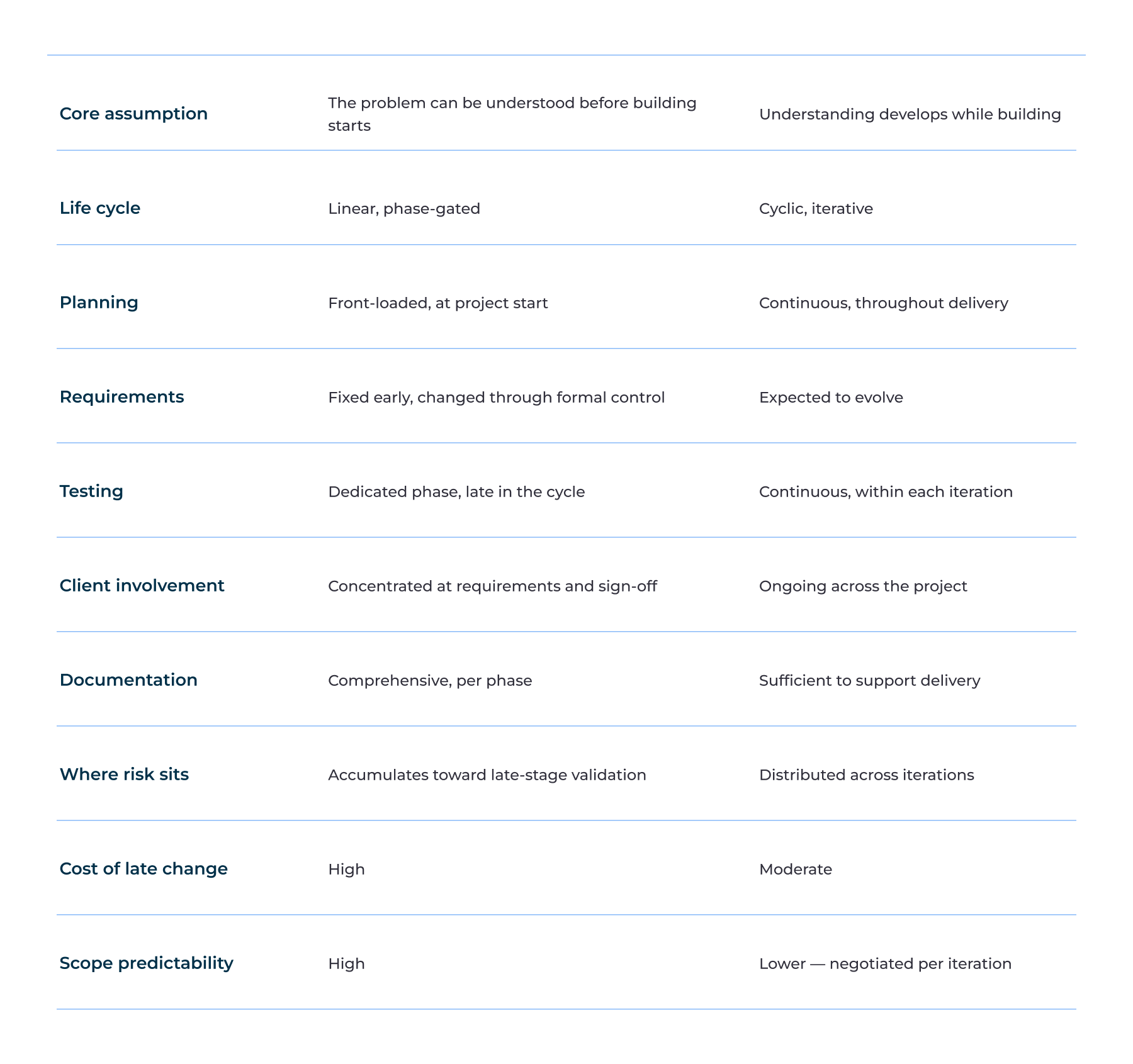
The Agile vs Waterfall question rarely turns on which approach is better in the abstract; it turns on which one matches the constraints already in place. Ten dimensions separate the two families of software development solutions, and most selection arguments come down to disagreement about three or four of them.
Which Methodology Fits Which Project
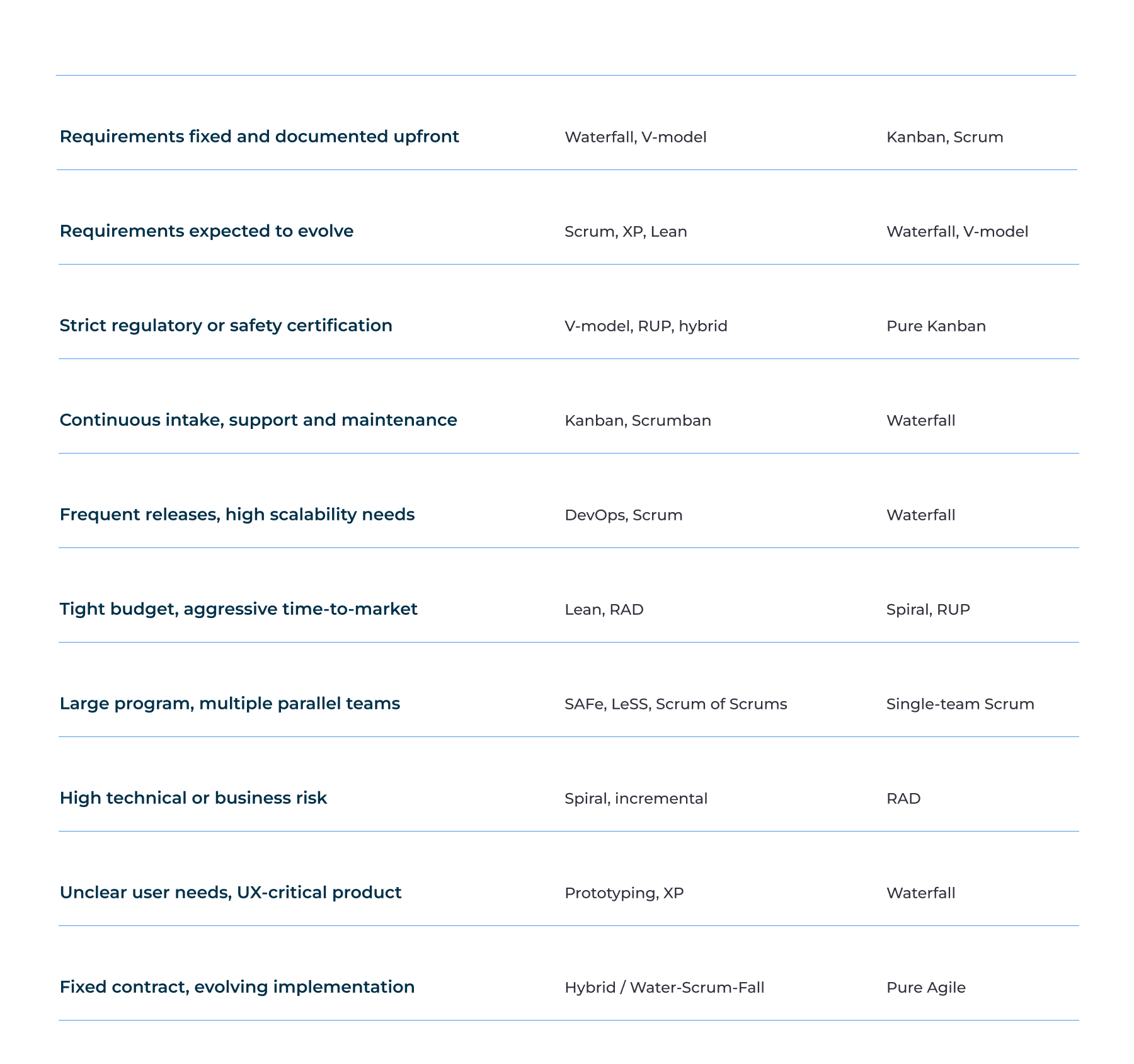
Nobody selects a methodology from a blank slate. By the time the question comes up, a contract type is already decided, a budget period is in place, there’s a compliance obligation or lack thereof, and a team is assembled with a certain level of maturity. The question «which software development methodology is the best ever» has already been answered, and a shortlist of two or three approaches is in play for the job.
The table below maps common project conditions to the models worth considering and the ones worth ruling out. Most real programs match several rows at once. For example, a regulated platform build with an aggressive launch date matches three, and where those rows disagree is exactly where the decision actually sits. This is precisely the point where disagreement is most productive, because it names the trade-off that is being made, rather than leaving it to discovery later in the sixth month. Knowing which software development methodology to choose is a matter of articulating which constraint is non-negotiable.
How to Choose a Software Engineering Methodology
Seven questions narrow the field faster than any comparison of features does. Each of them asks what the organization has already fixed in place, because those constraints are what a delivery approach has to survive. Knowing how to choose a software development methodology is largely a matter of asking them in the right order.
Requirement Stability
Stability means one thing here: how likely is the specification to change after work begins? Answer it honestly rather than aspirationally. A payments integration against a published API specification is stable. The endpoints exist, the contract is documented, and the acceptance criteria can be written before the first commit. A customer portal replacing a process nobody has mapped is not, however confident the initial software product development brief sounds.
Sequential models reward genuine stability with predictable cost and schedule. Iterative models absorb change at the price of scope certainty. Choosing a sequential approach for unstable scope produces a change-request backlog that eventually costs more than the original build.
End Users and Their Access
Two questions about users matter, and the second is the one that gets skipped. First: are their needs fixed or moving? Second: will they actually be available during development?
Agile depends on a feedback loop that only closes if someone with authority to judge the work shows up regularly. A methodology built around fortnightly review sessions fails quietly when the business representative attends one review in four and sends comments by email a week later. Some users are genuinely unavailable: clinical staff on shift patterns, field technicians, external customers with no obligation to participate. For them, a model that front-loads requirement gathering into scheduled workshops beats one that assumes continuous access.
Project Size and Complexity
Size shapes the coordination problem. Below roughly ten people, any of these models works, and the choice matters less than the team's discipline. Above that, the question becomes how teams coordinate: shared backlog, cross-team standup, or a formal program structure.
Complexity is the more useful variable. A large system with few interdependencies scales through parallel teams and light coordination. A smaller system touching six regulated interfaces needs architectural governance regardless of headcount, and no amount of sprint cadence substitutes for it.
Timeline and Release Cadence
Unlike shorter initiatives, long programs have the challenge that the team finishing them is rarely the team that started them. The turnover in personnel, technology, and business priorities that occurs over multiple years favors approaches that deliver working software earlier rather than later.
Release cadence is a separate constraint often confused with timeline. A team doing two-week sprints can still release on a quarterly basis. Suppose there's a change advisory board or parallel validation cycle between the feature freeze and production deployment. Find out where the actual release authority resides before getting sucked into a faster rhythm than the business requires.
Team Location and Time Zone Overlap
Distribution constrains which coordination mechanisms work. Practices built on real-time interaction — pair programming, daily standups with a full development team present, whiteboard design sessions — degrade as overlap shrinks. Below about three shared hours, they degrade badly.
Distribution does not rule out iterative delivery. It rules out specific practices, which is a different problem with different solutions: asynchronous standups, written decision records, and a longer iteration to reduce coordination frequency. Waterfall is not the automatic answer for distributed work. It is one answer, and it trades a coordination problem for a change-cost problem.
Team Maturity and Experience
A methodology magnifies whatever capabilities your team already has, which is why the same framework often delivers wildly differing results when rolled out in different organizations, even if both quote the same success rate for their pilots in the same quarter.
Look at what Scrum actually requires: engineers able to break work down themselves, a product owner who can say no to stakeholders. Also, it should be enough test automation that a two-week increment can actually be tested in that timeframe. A team missing those does not get Scrum by holding Scrum ceremonies. It gets standups, a board, and the same delivery problems it had before, now with additional meetings. Extreme Programming asks for more still — pairing discipline and test-driven development are learned practices, not policies that take effect on announcement.
Stabilize where you're at before trying to move to the next level. A team that has discipline in their Kanban with proper work in progress limits is going to get more consistent delivery out of their process than the same group trying to implement large-scale SAFe.
Budget Structure
Structure constrains the choice more than the total figure does. Three questions decide it:
- is the budget fixed or flexible;
- can funds move between phases once allocated;
- does the funding cycle allow scope to be renegotiated mid-program.
A fixed-price contract with a defined deliverable set is a sequential structure, whatever the delivery team calls its process. The commercial terms have already fixed scope, and running sprints underneath does not unfix it. Time-and-materials arrangements or internal budgets with reallocation authority support iterative approaches. Scope can genuinely move without a contract variation. Annual capital budgeting sits between the two and is a common reason organizations end up in Water-Scrum-Fall without having chosen it.
Where the commercial structure and the delivery approach disagree, the commercial structure wins. Project management practice can absorb some of that friction. But no amount of process design makes a fixed-scope contract behave like an adaptive one.
Why Following a Methodology Matters
A development methodology earns its overhead in four places. None of them is process discipline for its own sake.
- Software that matches what people actually need. Every methodology defines when the people paying for the work get to see it and correct it. Sequential models concentrate that moment at requirements sign-off, iterative models spread it across the build, and both work. What fails is having no defined moment at all. Teams without one discover the mismatch at launch, which is the most expensive point in the software development process.
- Delivery that lands when it was promised. Predictability comes from a defined cadence, not from optimism about estimates. Fixed iterations give a team measured throughput to forecast against. Phase gates give a program a scheduled point to compare plan against actual. Programs that drift usually do so because nobody defined what «on track» means until someone asked whether they were.
- Quality built in rather than inspected in. Where testing sits in the life cycle determines what defects cost. The V-model pairs every design activity with its verification. DevOps pipelines fail a build within minutes of a bad commit. Waterfall concentrates testing after implementation, which is why a specification defect found there is the classic expensive bug. The methodology decides which of those a team gets.
- Lower total cost across the life of the system. Rework is the highest controllable cost in software delivery, and every model handles it differently. Cost control also depends on measurement, and a team that tracks Agile metrics like cycle time and escaped defect rate can see rework accumulating before it shows up in the budget. Teams without those numbers find out at the quarterly review.
How Intellectsoft Delivers Software
Intellectsoft has spent 18+ years building software for organizations that cannot afford a failed delivery, including 35 Fortune 1000 clients. The delivery process below is the same one those engagements run through.
Seven phases structure every engagement in our IT consulting.
- Project planning sets budget projections, a schedule with KPIs and milestones, team composition, and the scope of each development phase. Nothing moves to analysis until those are agreed in writing.
- Business analysis turns that scope into software specifications. Business analysts document functional and performance requirements against stated business objectives, which becomes the reference point every later phase is measured against.
- Design runs on two tracks at once. UI/UX specialists build mockups while a solutions architect designs the solution infrastructure, so interface decisions and architectural constraints surface together rather than in sequence.
- Development is led by a project manager who stays with the engagement through every subsequent phase. Work runs in sprints with a dedicated development team assigned to the customer.
- Quality assurance puts the build through structured testing before anything reaches an end user. Defects found here are cheaper than defects found in production.
- Deployment moves the solution into the customer's environment and into the hands of its users.
- Maintenance continues after launch, covering new features, changes, and the ongoing support most engagements need once real usage begins.
Scrum by Default, and When It Is Not
Scrum is the default engagement model for Intellectsoft’s team. Two-week sprints, a dedicated project manager, and a review cadence that gives the customer visible progress and a decision point every fortnight. It suits most custom software development services work because scope refines during the build, and a fortnightly review surfaces a misunderstanding while correcting it is still cheap.
Where a regulatory body requires verification evidence against each requirement, the V-model or a documented hybrid fits better than a pure sprint cadence. Where an engagement is a fixed-price build against a signed specification, sequential phases match the commercial structure. Where the work is ongoing support with unpredictable intake, a pull-based flow serves the customer better than sprint commitments nobody can hold. The delivery approach is set during planning, against the constraints of that specific engagement.
Two Engagements, Two Delivery Models
Eurostar. Western Europe's high-speed rail operator needed a passenger experience system covering onboard service management, real-time updates, and passenger information processing across web, iOS, and Android. A dedicated development team spanning analysis, design, mobile and backend engineering, data, and QA built it in sprints. Story mapping broke the passenger journey into work that both the team and Eurostar's stakeholders could track. The design track ran on user flows and wireframes before implementation began.
Skroote. A streaming content aggregator arrived with a product concept and no funding. The engagement started as a prototype rather than a full build, which suited a market where the idea had to be demonstrated before anyone would finance the platform. That prototype secured funding for the beta and the MVP. The architecture underneath it — Java on the backend, React and React Native sharing a single codebase across desktop and mobile — carried through to the production platform instead of being rebuilt. Prototyping and MVP delivery are separate models. Running them in sequence is what lets a concept reach users without a full-scope commitment upfront.
Full client case studies cover the delivery detail behind these engagements, including team structure and release cadence.
Every engagement starts with a conversation about constraints rather than a proposal. Book a call to talk about scope, timeline, and regulatory requirements, and get a recommended delivery approach before any commitment.
Conclusion
No ranking of software development methodologies survives contact with a real project. Waterfall is the right answer for a certification-bound build and the wrong one for a product nobody has scoped. Scrum is the right answer for evolving scope and the wrong one for a fixed-price contract. Selection follows from conditions already in place — requirement stability, regulatory exposure, team maturity, budget structure, release authority — rather than from any judgment about which model is superior.
Hybrid delivery is where most organizations land, and it deserves better than being treated as a failure to commit. Sprints inside a phase-gated release process, Agile feature work alongside a V-model safety subsystem, sequential planning above iterative execution. These are deliberate designs answering constraints that will not move. The mistake is not the hybrid. It is running one by accident and never naming the trade-offs it imposes.
FAQ
What is the difference between Agile and Scrum?
Agile is a set of values. Scrum is one framework that implements them. The 2001 Manifesto — seventeen practitioners, four values, twelve principles — described how software should be built without naming a single practice, role, or meeting. Scrum supplies all three:
- a product owner who decides what gets built next;
- a Scrum master who clears obstacles;
- a development team that owns delivery, plus planning, daily standup, review, and retrospective.
Extreme Programming and Kanban implement the same values through entirely different structures. Running every Scrum ceremony on schedule does not make a team Agile. Kanban, Extreme Programming, and Lean are ways to work that support and carry out Agile values and principles.
What are the most common software development methodologies?
Scrum dominates at team level, with Kanban a distant but substantial second, and DevOps has become close to standard for how software ships and runs. Survey data varies by respondent pool: Digital.ai's State of Agile, which polls Agile practitioners, reports far higher Agile adoption than the Project Management Institute, which polls project professionals across all industries. Waterfall persists in regulated and contract-driven work.
Which software development methodology is best?
There is no one best, and any prioritization that fails to consider this is wrong. The choice is dictated by three factors:
- how stable the requirements are;
- how far the team has progressed in the practices the methodology is based upon;
- what release strategy the organization is able and willing to implement.
A regulated build with certification obligations and a consumer product with unknown user needs will not land on the same answer. Match the model to the constraints already in place rather than to a reputation.
Can different methodologies be combined?
Yes, and most organizations already do. Common combinations pair Scrum for feature development, Kanban for maintenance and support intake, and DevOps for release and operations. For example, Water-Scrum-Fall runs sequential planning and release management around sprint-based development. Scrumban keeps Scrum's roles while replacing sprint commitment with pull-based flow. Combining different types of software development methodologies works when the split is deliberate. It fails when nobody acknowledges the hybrid exists and teams commit to sprint goals that a quarterly release cycle makes meaningless.
Which methodology suits startups best?
Lightweight Agile or an Agile–Lean hybrid, in most cases. The deciding factor is how fast a startup can invalidate an assumption without burning engineering capacity on something nobody wanted. Short iterations with real user contact do that.
Scrum is good for teams that have the discipline to use it, while pure Kanban makes more sense in the case of up to 3 or 4 engineers, where the sprint ceremonies are a higher cost than benefit. Prototype and MVP approaches make the most sense at the beginning, where there is nothing to iterate yet.
Is DevOps a software development methodology?
Not strictly. DevOps, as an operating model, defines how software is delivered to production and operated within it. This paradigm encompasses such concepts as continuous integration and delivery, infrastructure as code, and observability. In this regard, a planning methodology determines what will be built and when. DevOps dictates the way of its delivery and response to failures. The two are independent choices — a team can run Scrum with quarterly manual releases, or continuous deployment against a Kanban board. DevOps complements a methodology rather than replacing one, which is why it appears among modern software development methodologies despite not being one.
Which methodologies work for regulated industries?
The V-model, RUP, and documented hybrids handle regulatory demands best, because each produces traceability between a requirement and the evidence that it was verified. Regulation constrains documentation, verification, and sign-off, but it does not prohibit iteration. Regulated organizations run sprints routinely. What they cannot do is deploy to a validated environment without completing the approval cycle. The practical answer is usually a hybrid: iterative development inside a governed release process, with the compliance artifacts produced as work happens rather than assembled afterward.
What is behavior-driven development?
Behavior-driven development (BDD) is a specification and collaboration methodology. Three people read the same requirement and picture three different products. BDD attacks that directly. Before anyone writes code, the expected behavior goes into a scenario a product owner, a tester, and an engineer can all read. Given a customer with an expired card, when they submit an order, then the payment is declined, and the cart is preserved. Arguments happen at that sentence, where they cost nothing. The scenarios then run as automated acceptance tests, so the specification and the test suite stop drifting apart. None of this changes how work gets planned or sequenced — BDD sits inside Scrum, Kanban, or anything else. It changes how requirements get written down and who gets to disagree with them.
How long does adopting a new methodology take?
Basic mechanics take weeks. Proficiency usually takes three to six months, and organization-wide change takes longer still. The variable is rarely the framework itself — teams learn ceremonies quickly. But the practices underneath it: test automation, backlog discipline, and a product owner willing to make decisions. Team size and genuine leadership support move the timeline more than anything else. Adoption that stops at the ceremonies produces the appearance of a new methodology with the delivery behavior of the old one.
Which methodology is most cost-effective?
Cost-effectiveness depends on where a methodology lets waste accumulate rather than on its overhead. Approaches that delay feedback push cost into late-stage rework, where fixing a misread requirement costs many times what it would have during design. Approaches that shorten feedback loops spend more on coordination and accept less scope certainty. For stable, well-specified work, sequential delivery is often cheaper. For anything with genuine uncertainty, iterative delivery costs less overall because it stops the wrong thing being built for months.